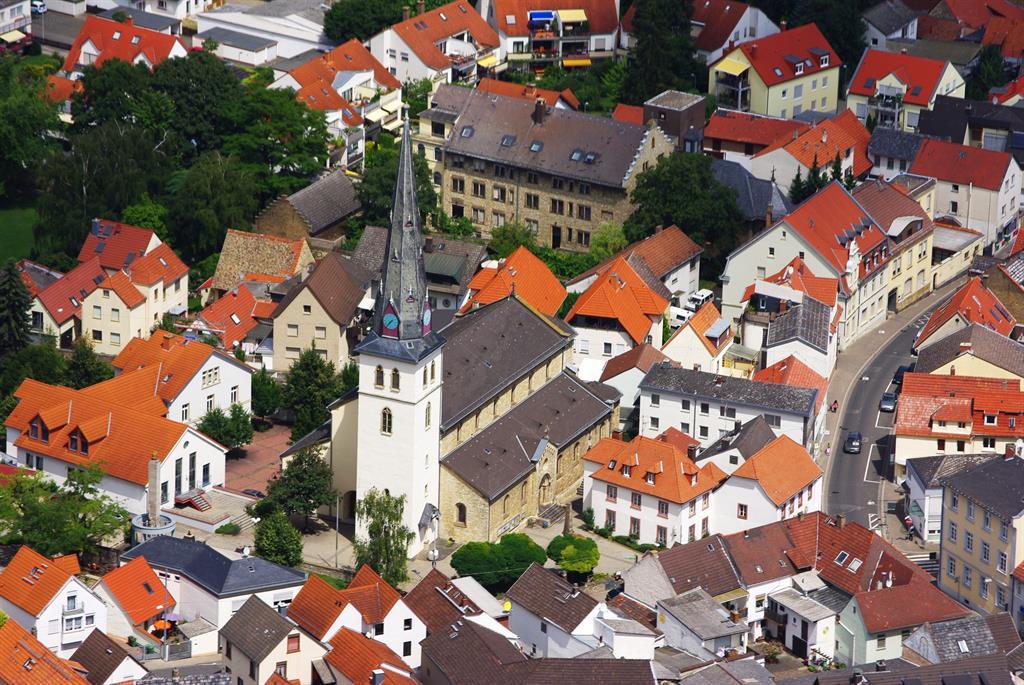
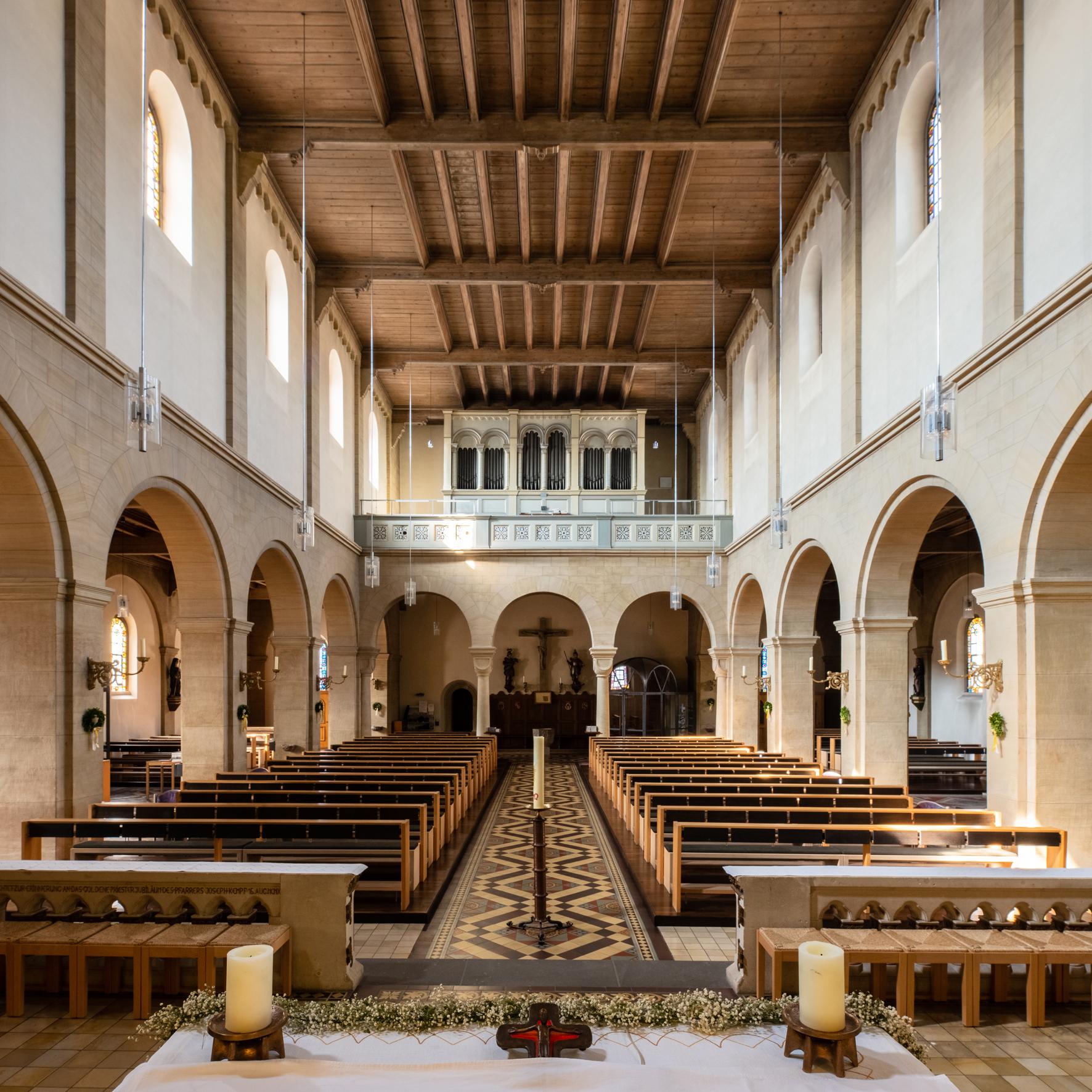
The church is a rectangular nave with an elevated central nave and a flat wooden ceiling. The masonry consists of naturally finished light rubble stone. The 33.5-meter long central nave is separated from the side aisles by rectangular arcades.
The building is asymmetrically attached to the 50-meter high tower, whose lower part is the oldest section of the church building. Under Pastor Joseph Kempf (1887–1913), the tower was raised because the new building obscured part of the sound holes and affected the ringing effect. The inserted "storey" therefore lies clearly above the ridge of the nave and today serves as the bell chamber.
The right side aisle has two entrances: the south portal and the entrance to the Mother of God Chapel. The south portal, originally the main portal, is flanked by a column with a cube capital, whose lines continue into the wall bulges of the arch. In the tympanum between the door lintel and arch is a bas-relief of a "surrounded cross." The current west exit, used as the main portal, is comparatively plain and was originally intended as just a small "door."
The entrance to the Mother of God Chapel is framed by two columns with leaf capitals. In a wall niche above the arch stands a statue of Mary from the 19th century. On the southern outer wall of the tower is a stone cross from the second half of the 17th century, created under Pastor Jacob Spang (1668–1689). In World War II, the corpus was damaged, later restored under Pastor Sylvester Hainz (1960–1981) and reattached to the cross.
A crypt exists due to the sloping terrain on the east side of the church, but it is not a true underground construction. Today it serves as a storage and heating room and is only accessible from the outside.
Near the west entrance stands the massive baptismal font from the old church, which had long been lost and was rediscovered on a farm as a watering trough. The year 1492 is inscribed on one side, presumably the year of its creation. The stone belongs to the so-called "lion baptismal fonts," whose base was originally supported by four lying lions – these are no longer preserved. Today, the baptismal font serves as a holy water font.
On the western back wall stands a crucifixion group: The cross is not framed, as usual, by Mary and John, but by the church patrons St. Martin and St. George. Both wooden figures, carved around 1700, come from the old church. The crucifix corpus itself comes from Mittelheim in the Rheingau.
The walls of both side aisles are adorned with figures of saints, collected from various sources. Significant representations include the saints Boniface, Anthony of Padua, John the Baptist, Francis of Assisi, Roch, Wendelinus, Aloysius, and Sebastian. The figure of St. Christopher on a column comes from Merano in Tyrol.
In the left side aisle, there is another baptismal font from the old church, whose lid shows the baptism of Jesus by John in the Jordan. The gable of the left side aisle is adorned with the cross altar from 1906, featuring reliefs of the finding of the cross and the exaltation of the cross. The outstanding cross also comes from the old church and was created around 1700.
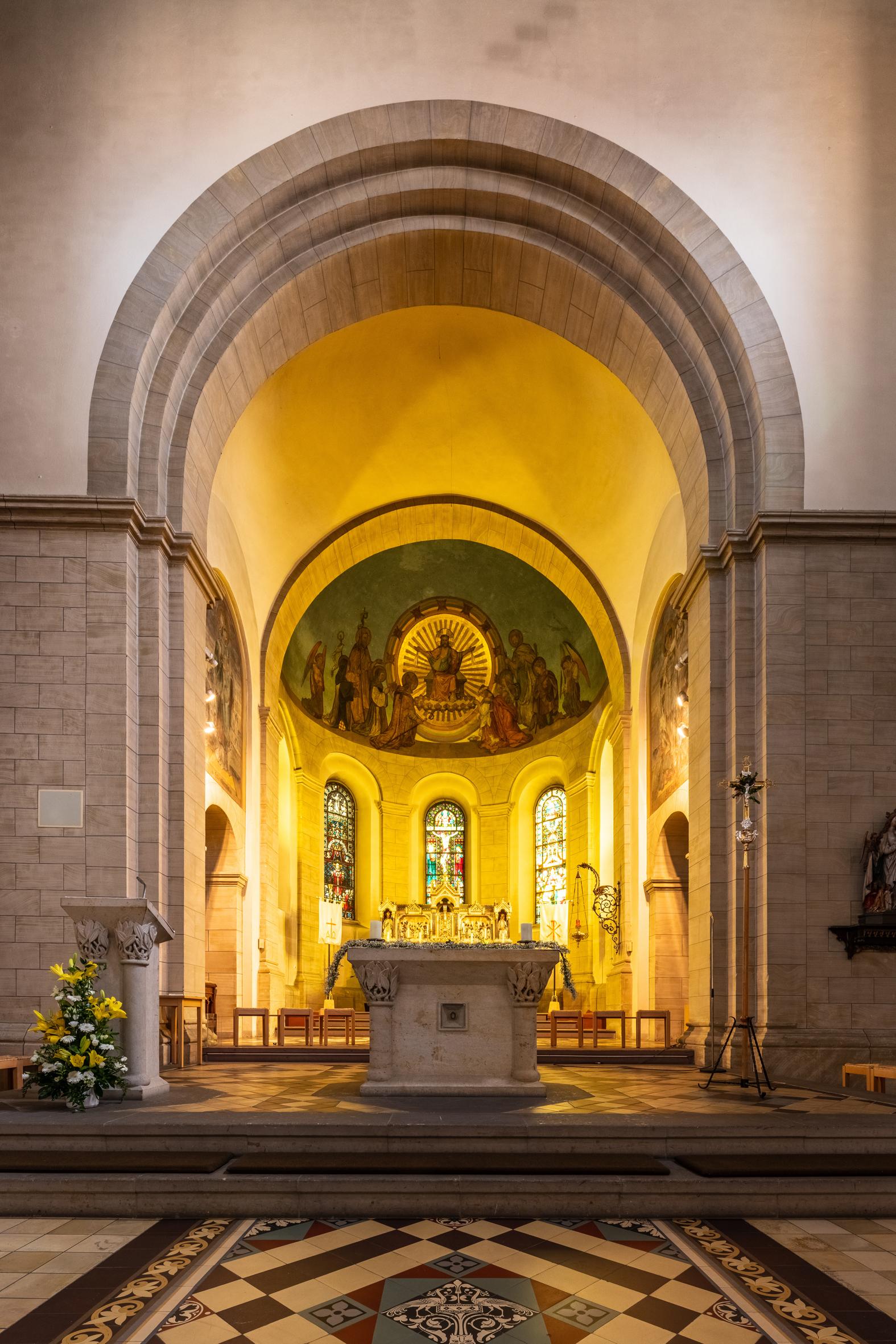
In the chancel, there is a modern celebration altar made of natural sandstone with a matching ambo at the front. Particularly notable is the reliquary grave: The relics are visible on the front of the base behind glass, unlike usual, which are embedded in the altar slab.
The high altar in the apse dates from 1900. Beneath the altar table made of red sandstone are five white Courson reliefs related to the Eucharist, which is kept in the tabernacle. The altar structure depicts the wedding at Cana and the last supper. The apse conch is painted with Christ and saints connected to Germany, the Diocese of Mainz, or the parish community. Also depicted is the Finther virgin Agnes Pfeifer, murdered in 1754 – without a halo.
On the right choir wall stands the late Gothic mantle Madonna made of lime wood (1.10 m), a work of high significance. Mary holds the infant Jesus in her arm, while angels hold her wide mantle spread out, under which people of all ranks find protection.
The right side aisle choir chapel is the Mother of God Chapel, which was redesigned in 2003 and separated from the rest of the church by a grille. The Marian altar dates from 1892; the side wings of the altar structure, remodeled in 1935, depict scenes from the life of Mary. A baroque figure of Mary from the old church stands above the tabernacle. Here are also the graves of the virgin Agnes Pfeifer and Pastor Joseph Kempf. The chapel is accessible during the day through its own entrance.