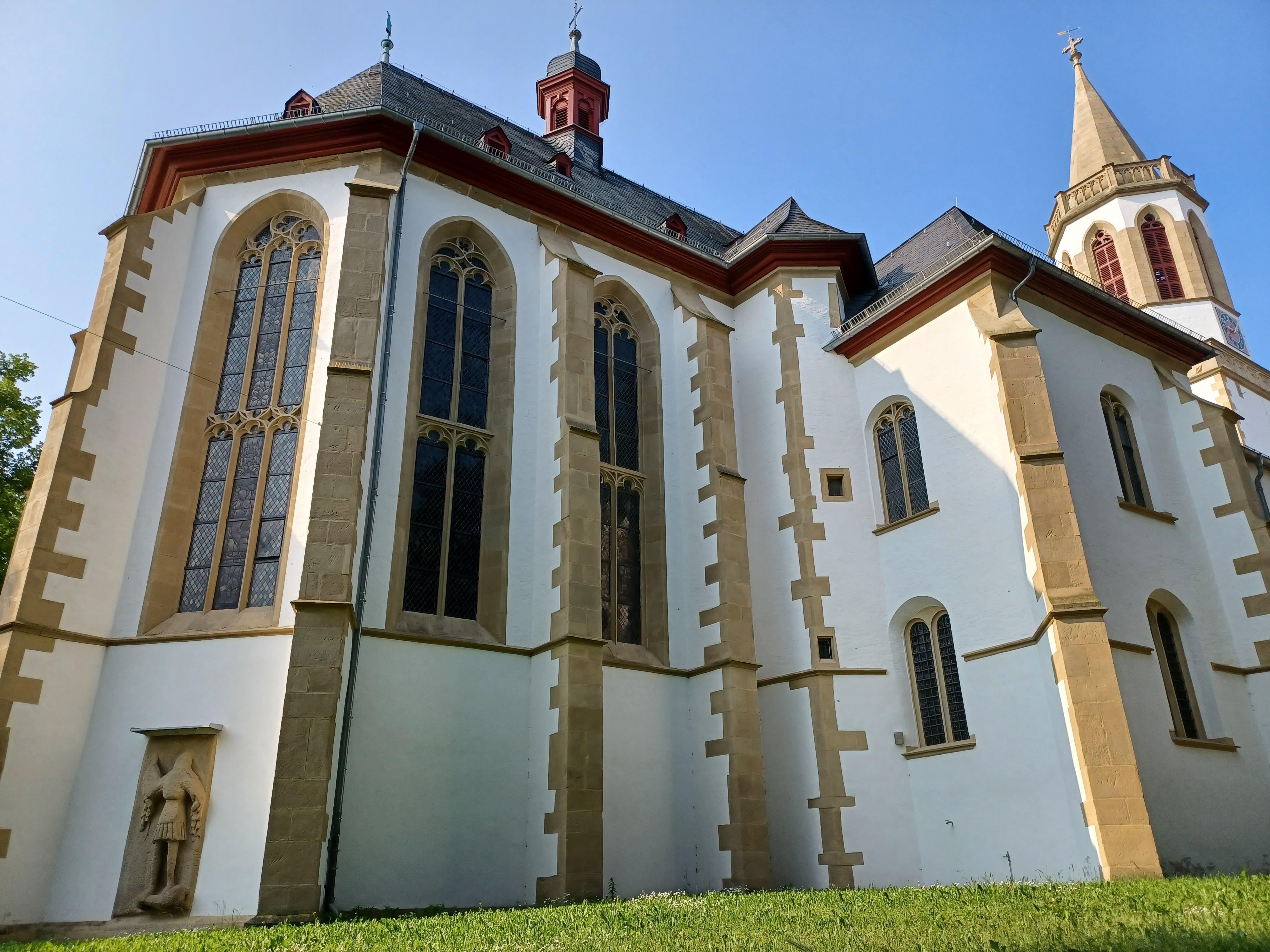
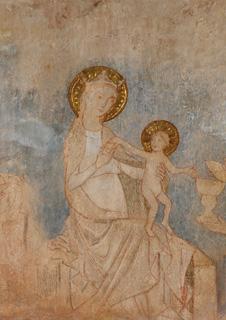
Located below Petersberg, the town enjoyed the rights of a free imperial city in the Middle Ages. Its former importance is evidenced by the large church building, which replaced a predecessor of similar dimensions where the relics of Saint Rufus, Bishop of Metz, were venerated. Since 1705, the church has been divided into a Protestant section (nave) and a Catholic section (choir) by the closure of the choir arch. The two-nave, flat-roofed nave was built around 1420 under Johann von Diepach. Numerous 15th-century murals have been preserved in the north aisle (Adoration of the Kings, Passion cycle, saints, Last Judgement). The strikingly long and high choir was built between 1497 and 1507 under Master Arnold from Frankfurt.
The large, transversely divided tracery windows extend up to the vaulted ceilings and, like the colour scheme reconstructed according to findings, emphasise the height of the impressive space.