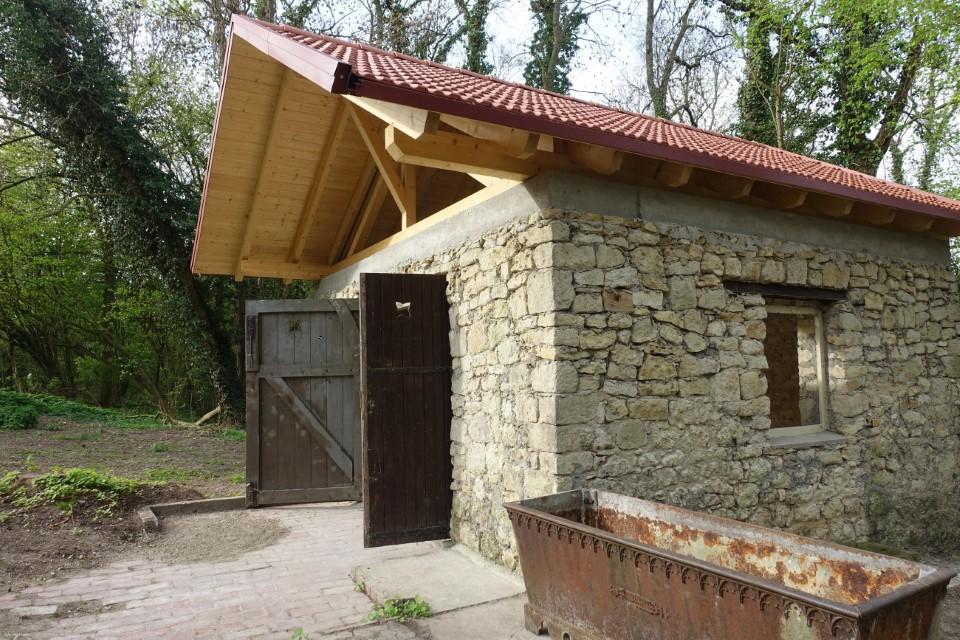
The Wackernheim council decided in 1860 to acquire a local bleaching site. In 1862, the necessary plot of about 3,800 m² was purchased from a total of ten different owners.
The grass bleaching was a process in which white laundry, such as sheets or tablecloths, was freed from its gray veil. The washed linen or hemp textiles were spread out on the grass and continually moistened. The interplay of sunlight, water, and oxygen from the grasses triggered a chemical reaction that produced hydrogen peroxide in small amounts as a bleaching agent.
It wasn't until 1871 that the bleaching house was built at the west end of the site. The remaining field bricks were used to enlarge and repair the leaky water containers on the bleaching site.
After progress rendered the labor-intensive grass bleaching unnecessary, fish farming was practiced on the site for decades. In 2017, the municipality began the renaturation of the area.
A contemporary witness recalled: In our childhood, we were regularly sent there with the "Kannche," a four-wheeled cart, with bedding and white items and a watering can. We spread the laundry out and soaked it with well water. Once the stuff was dry, it was turned and re-wetted. This happened several times while we played around the large well coffin until the setting sun reminded us and the laundry it was time to go home. (Otto Herrmann 1921-2012)