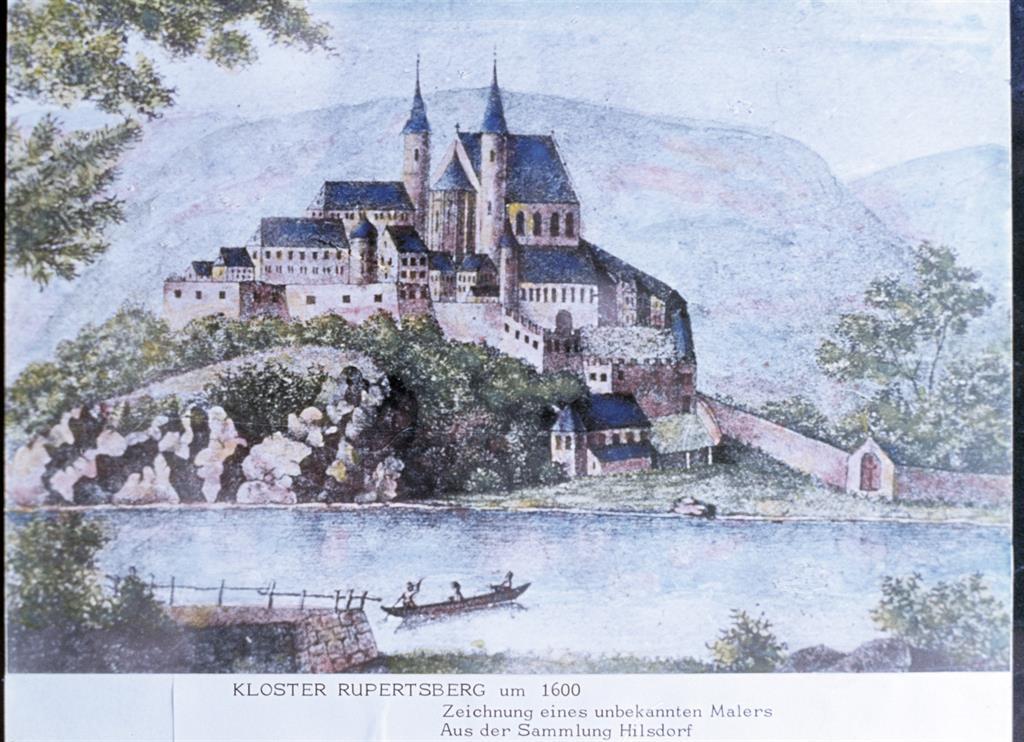
Around 1150 Hildegard of Bingen left the women’s cloister at the Disibodenberg monastery with 20 companions after her first work "Liber Scivias" had gained great notoriety. She founded her first own monastery on the Rupertsberg near Bingen. Here, the abbess, who now abandoned her secluded cloister life in favor of a public role, connected to the important trade routes of the Rhine. Most likely between 1155/58 and 1165, the new monastery complex was created with the three-nave, representative church at its center. During her nearly 30 years at Rupertsberg, most of Hildegard's works were created. In 1632, during the Thirty Years' War, the monastery was destroyed. The sisters, parts of the monastery inventory, and the relics of Hildegard found refuge at the Eibingen monastery near Rüdesheim. The Rupertsberg ruins were subsequently used by the convent as an agricultural estate until the majority of the remaining building substance had to make way for the construction of the Nahe railway in the mid-19th century.
The vaulted cellar at the historic site is maintained and made accessible by the Rupertsberger Hildegard Society Bingen e.V.