
searchMenu

The Love Nest Built by Daniel Graf from Monzernheim in 1934. It is a brick building with a concrete flat roof and a rubble stone foundation. Inside, a small bench has been placed all around. The eastern wall clearly shows that it was a popular shelter for lovers and still is. Height: 182 Area: "In the middle valley" known as "Rabbit Hole" History / Stories / Anecdotes: The current owner is the Keller Winery / Flörsheim-Dalsheim (since 2014). Previously, it belonged to the Mayer Winery from Ober…

Built in 1750. The village blacksmith shoed horses, produced waggon wheel metal for carriages and repared small devices for the agriculture and the wine growing. The last active blacksmith let the fire go out forever in 1959. In 1989 the municipality could buy the forge together with its furniture and preserved an authentic testimony through useful additions of the equipment.
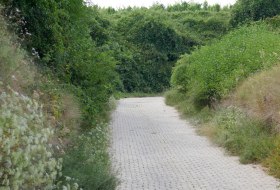
The Kirschbühl Hollow To describe the formation of a hollow way, one cannot avoid taking a look at the loess. The loess that was blown to us during the last Ice Age consists of 20% lime and remains stable in its angular shape at the cliff edges and in the hollow ways. By driving vehicles on the hollow ways, in earlier years with carts and livestock, the loess is loosened and turns to dust. During heavy rain, the loose soil is washed away, leading to ever-deepening paths - a hollow way is created. Today, many hollow ways are paved to…

The formerly Gothic church was devastated, and the consecration of the current Baroque church took place in the year 1715. The preserved chancel of the former church is still used today as a sacristy. The Baroque altars, which are unusual for a small village church, are particularly noteworthy. From this period date the donation box and the baptismal font. The colored stained glass windows designed by an artist from Mainz in 1906 depict beautiful saint motifs. Next to the high altar, one can see the statues of the church patrons Philip and…

From 1904, Frei-Weinheim had a railway connection for goods and passenger traffic for exactly 50 years. The former train station building in Heimat style is still preserved. The single-track Selztalbahn connected the Rheinhessen hinterland from Jugenheim-Partenheim to the port in Frei-Weinheim. In Nieder-Ingelheim, there was a connection to the left bank Ludwigsbahn, which had been running between Mainz and Bingen since 1859. Since the Selztalbahn was primarily used for the transport of sugar beets, it was nicknamed…

The Bunte Bühne has been providing theater enjoyment in Armsheim for over 20 years. The repertoire includes comedies, farces, and crime comedies written by internationally known theater authors. The stage is a registered society and a member of the Rheinland-Pfalz state association of German amateur theaters. Rehearsals: At the beginning of the new playing season mainly on Tuesdays and Thursdays at 8 PM, by prior arrangement/planning. We traditionally perform on the first weekends in November - usually five performances.
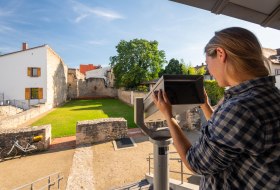
The Aula regia, the throne hall of the Ingelheim imperial palace, was built at the end of the 8th century and is part of the founding building under Karl the great (747 / 48−814). The throne hall was the most important public building and served as a representative meeting place. This shows also on the basis of their high-quality building equipment, the remains of which were found during archaeological excavations. Parts of the from antiquity Inspired building jewelry, including fragments of the wall paintings and the precious…

The Trullo - the Trulli - the special vineyard cottage in Rheinhessen. Former shelters in the vineyards for the workers, but also intended for the "Wingertschütz" who guarded the vineyards. This vineyard cottage stands out in the form.