
searchMenu
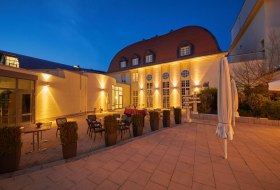
After a chequered history, culture moved into a building erected in 1925 for the Freemasons in 2003. Seminars, conferences, theatre and concerts take place in the pleasant and spacious ambience of the House of the Guest and ensure a varied programme all year round. The concert and theatre hall is the centre of the House of the Guest. There is room for about 200 visitors. Two seminar and lecture rooms are also part of the room programme. The ideal place for conferences and congresses. Exhibitions by contemporary artists enrich the…

As the former Dalsheim town hall, the building was once the centre of the village administration. The earlier designation "by dem Dantzhuse" refers to a larger hall that served the village community as a festival hall and meeting room. A community hall that was destroyed in the Palatinate War of Succession in 1689 is mentioned in 1674. Today, the building is used as a training room for the Malteser as well as a storage room. (Text using the historical place name signs with kind permission of the OG, own additions)

The menhirs date back to prehistoric times. Of the once larger group, three are still preserved today. The well-known "Hinkelstein" is still located near its original site at the southern edge of the village. The other two stones, the "Dicke Stein" and the "Spitze Stein," were moved during land consolidation and are now situated on a property near the Wiesbach Bridge on Bahnhofstraße. The "Dicke Stein" has been re-erected there, while the "Spitze Stein," which is broken into two pieces, lies on the ground a few meters away. A…
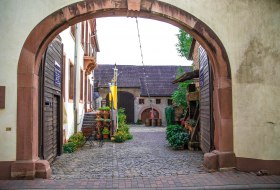
On the KulTOUR around the Nierstein market square, you can expect exciting stories about Nierstein's noble courtyards, underground secret passages and the old village smithy. The tour starts at the Haxthäuser Hof in Langgasse 35. All you need for this tour is a smartphone with a QR code scanner. Each building on the tour has a QR code with interesting facts behind it. A total of 16 stations invite you to get to know Nierstein better on your own. After the tour, you can stop off at one of the restaurants around the market square or start…

Heute ev. Gemeindehaus, Gründung im 9. Jahrhundert durch Kloster Hornbach. Der romanische Turm ist aus dem 13.Jh. Im Pfälzer Erbfolgekrieg 1689 teilweise zerstört und 1707, nach der Pfälzer Kirchenteilung, an reformierte Gemeinde übergeben danach Wiederaufbau 1708-1712 mit barocker Turmhaube aus dieser Zeit. Stummorgel und Holzausstattung aus dem 18. Jahrhundert. Auch Sommerkirche genannt, da damals keine Kirchenheizung vorhande. Seit 1979 wird das Gebäude als Gemeindezentrum genutzt Text Beschilderung mit…

A church in Monsheim was first mentioned in 1496 - a fortified church in the Romanesque style. The bell tower with its three bells dates back to 1878. In 1904/05, the form that can be seen today was created by adding the vestibule on the north side and creating a choir room. A modernisation phase from 1965-74 gave the church interior a rather cool objectivity. The interior renovation carried out in 2000 gave the church back its Art Nouveau paintings and thus its special touch. Text taken from Rundgang Monsheim with kind permission.Former…

The Catholic Church in Köngernheim is a branch church of St. Walburga in Friesenheim and today belongs to the parish of St. Mary Magdalene. Since its foundation in 2016, this parish has comprised the parishes of Friesenheim, Undenheim, and Weinolsheim. The church was consecrated in 1932. The interior of the church building is a simple space.
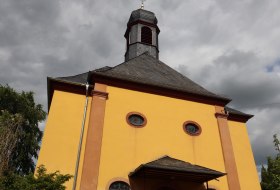
The Catholic parish church of St. Walburga was built in 1740. The Baroque hall church with a choir enclosed on three sides was formerly used as a simultaneous church. On the gallery of the parish church, you will discover a real treasure: the single-manual, eleven-stop organ built in 1763 by Joseph Anton Onimus. It is the only surviving organ by the famous organ builder and was lovingly renovated in 1993 by the company Förster und Niclaus.