
searchMenu

The parish church of St. Quintin is considered the oldest parish church in Mainz and was first documented in 774. It is a late Gothic hall church that was built between 1288 and 1330. The tower, built in 1489, once housed a watchman's apartment. Today, it holds four bells, including the oldest bell in Mainz, the so-called “Lumpenglöckchen” – a bee-skein bell from around the year 1250. The high altar features a life-sized statue of Saint Quintin, the patron saint of prisoners, on the left, and Saint Blaise, the second…

Already in the 14th century, a ship's crane is evidenced at the Frei-Weinheimer bank. A first massive land crane was erected in 1549 after the model of the Binger crane (1487). The still visible foundation is a relic of the last crane powered by human labor, which was built around 1680. The rotating crane stand was embedded in the central shaft, to which the two tread wheels and the jib were attached. Two workers had to walk in the wheels to provide the drive for the system. Unloading and loading were subject to fees. The crane clerk kept a…

Do you think you have already seen the best view of the region? The Johannisberger Türmchen will prove you wrong. On the hiking trail "Rabenschule" between Gau-Algesheim and the Jakobsberg Monastery, a viewpoint awaits you with breathtaking panoramic views - from the Rhine valley to the Taunus. The chirping of birds and the rustling of vine leaves in the wind make this experience unforgettable.
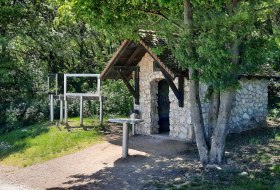
The Falkenberghütte, located above Dienheim, offers hikers along the RheinTerrassenWeg the opportunity to take a break. The hut, donated by the Dienheim Reconstruction Community, invites for a well-deserved rest after an eventful hike through the beautiful landscape. Two large panoramic windows reveal a fascinating panorama that opens up the view towards the historic Oppenheim and the charming Dienheim. The gentle hills of Rheinhessen with their picturesque vineyards provide a dreamy backdrop for beautiful photo motifs.

View pavilion with a table for wine above the Wiesbach cycling path. Guests are invited to experience the hospitality of Rheinhessen and enjoy the beautiful vista with friends, acquaintances, or newly made friends on the cycling and hiking trails, while having a snack or a glass of wine. The table offers enough space, and if you squeeze together a bit, there's always room for one more. In good weather, you can enjoy a splendid panoramic view.

The Ellernhof has been family-run for generations and has developed from a mixed agricultural operation to a pure winery with hotel. The vaulted cellar is in this case a barrel vault, a rather rare building in Rheinhessen. General information about Rheinhessen cow chapels The origin of the typical Rheinhessen vaults goes back to the early 19th century. At that time, farmers wanted to increase the yield of their cattle by keeping them in stables and use the leftovers as fertiliser for their fields. Initially, the cattle were housed…
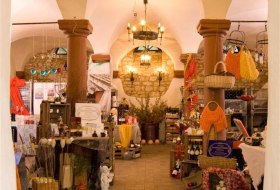
The cross vault in the Bernhard-Räder winery is used as a tasting and sales room for wines and other specialities such as brandies, various types of mustard and pesto. Always beautifully decorated, worth a visit! General information about Rheinhessen cow chapels The origin of the typical Rheinhessen vaults goes back to the early 19th century. At that time, farmers wanted to increase the yield of their cattle by keeping them in stables and use the leftovers as fertiliser for their fields. Initially, the cattle were housed on the…

A journey through 500 million years of Earth's history The museum houses an exceptionally extensive collection of fossils. A stroll through the museum allows visitors to trace the evolution of life over millions of years up to the present day. The paleontological museum in Nierstein displays geological finds from all over Europe. Here, past worlds come back to life. The fossil collection The museum houses more than 1,000 exhibits, most of which originate from Europe. The oldest fossils are around 500 million years old and offer…