
searchMenu
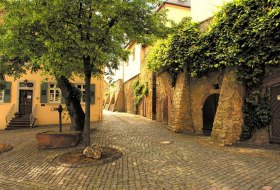
The cellar alley runs along the southern support wall of the marketplace. Here are the entrances to twelve vaulted cellars, which were already mentioned around 1600 and extend far beneath the marketplace. They are part of the once extensive and interconnected cellar system, another feature of the wine-growing village. Even today, some of the cellars are used for wine storage and can be visited during the annual cellar tour that takes place during the grape blossom festival.

Grandiose nature and centuries of human labor shape the landscape at the gateway to the UNESCO World Heritage Site of the Upper Middle Rhine Valley. Located directly at the gateway to the Upper Middle Rhine Valley, the signaling station Human|Nature|Technology presents this unique interplay of humans, nature, and technology at the Binger Loch. In the rooms of the former railway signal box Bingerbrück East (Bot), this unique interaction is made tangible and experienceable in a multimedia and interactive exhibition for young and old…

WELCOME to Rheinstein Castle on the Middle Rhine We are glad that you are visiting our Rheinstein Castle online! We are excited to introduce our castle to you on the next pages. Let yourself be enchanted by the romance and medieval flair of Rheinstein Castle and experience all the beautiful things live during your next visit to the castle. We would be delighted to welcome you in person soon

Whether from the A63, the Paris Street (L401), or the B420 towards Nierstein – the Protestant Mountain Church is visible from many directions and impressively situated among the vineyards. The building is oriented in the style of a Romanesque basilica and unites different architectural epochs: a square Romanesque tower, a Gothic nave, and a late Gothic choir. After a fire in the 16th century, the high choir was added with pointed arch windows and star vaults, so today only the central nave of the original three-aisled basilica remains.…

In 2004, two predecessor buildings of the Saal Church were discovered during archaeological excavations on the Saalplatz. The older of these buildings is a so-called tri-apsidal church (Trikonchos), named after its three semicircular building ends, which resemble the shape of a cloverleaf remember. It is an ancient building with a reference to Byzantine architecture. The eleven metre long sacred building from the 8th or The 9th century was connected to the north wing. Recent research suggests that it was a stately private chapel. Later the…

The clock tower, which is under monumental protection, is the landmark of the municipality Neu-Bamberg. Once it belonged to the 3 gates of the town fortification. The village owes its origin to the Neue Baumburg (Novo Boinburc), which was founded by the Raugrafen in 1253 and whose ruins still characterise the townscape today. Restored half-timbered houses, farms, gardens and the old water house give the village centre on the castle hill its unique charm.

As the former Dalsheim town hall, the building was once the centre of the village administration. The earlier designation "by dem Dantzhuse" refers to a larger hall that served the village community as a festival hall and meeting room. A community hall that was destroyed in the Palatinate War of Succession in 1689 is mentioned in 1674. Today, the building is used as a training room for the Malteser as well as a storage room. (Text using the historical place name signs with kind permission of the OG, own additions)

The Bornheim lookout tower is located in the middle of the sea of vines and offers a wide view over Rhine-Hessian Switzerland. This is also the location of the "Hiwwelrast", a wine tasting stand run by the surrounding winegrowers.