
Weingut Wohlgemuth-Schnürr
Andreas Schnürr
Katzensteinerstraße 45
67598 Gundersheim
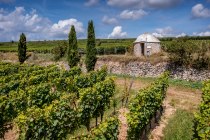
Over 50 vineyard cottages - and a single well cottage
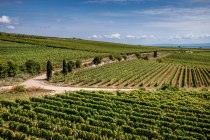
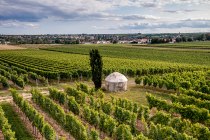
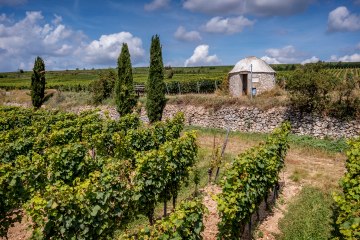
There is probably no village in Rheinhessen that could boast more vineyard houses: As many as 54 cottages adorn the vineyards of Westhofen. They were once shelters against the weather. In this particular one however, a spring was "protected" and a water reservoir was connected to it. The vineyard was first mentioned in a document in 1721 under the name "am brunnenhäusschen". The soils are characterised by clay marl with limestone and limestone rocks in the subsoil. “Terra Rossa", a red soil, is also found here. The winegrowers cultivate Riesling, Silvaner, Sauvignon Blanc or Pinot Noir. One of the highest vineyards in Westhofen.
> Interesting facts about the Westhofen Wingertshäuschen: https://www.wonnegau.de/wissenswertes-wingertsheisjer
From Wingertshäuschen to Wingertshäuschen: https://www.rheinhessen.de/wingertsheisje-wanderweg
> To the other single vineyards of Westhofen: Aulerde, Kirchspiel, Morstein and Steingrube
World famous and rich in stone
A bog (German: Moor) in Rheinhessen? Certainly not. The site was first mentioned in a document in 1282 with the name "in loco marstein" in a deed of donation to the Cistercian monastery of Otterberg (Pfalz) and can be interpreted as a "marker stone". In other words, it is a boundary stone or a landmark. It is indeed stony here: one stone found during clearing weighed up to 3.2 tons. In the upper soil layer, there are clay marl soils with limestone inclusions, and massive limestone rock underneath. Mineral Rieslings and Pinot Noirs bring world fame to the Westhofen winemakers. There are also plenty of vineyard cottages here, like the “Wingertshäusje Kommandozentrale".
> From Wingertshäuschen to Wingertshäuschen: https://www.rheinhessen.de/wingertsheisje-wanderweg
> To the other single vineyard sites of Westhofen: Aulerde, Brunnenhäuschen, Kirchspiel and Steingrube
No devil to be seen! Red wines on the famous southern slope
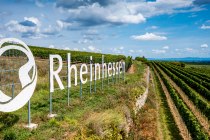
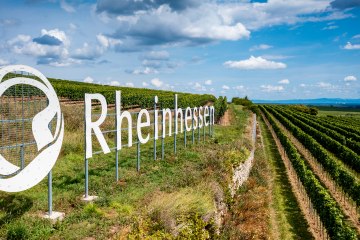
A significant landmark of the area: The imposing "Höllenbrand" sign, visible from afar on the A61 from Worms towards Alzey. Since 2016, the Rheinhessen logo has also been displayed on the terraced slope, which is 100 percent south-facing. The site was first documented in 1437 with the name "in dem hilprant" and in 1710 with the name "im Höllenrand". Both, the personal name Hildebrand and the Middle High German word "halde, hel, hölle" (for slope) could be the origin of the name. And the word "Brand" could belong to the Middle High German word "rant" and mean "mountain edge". So the hell fire has nothing at all to do with the devil. But the southern slope is as hot as hell: that's why winegrowers plant vines here for full-bodied wines, often red wines. It's a good thing that the soil - loess loam and limestone - has natural springs.
> Info about Gundersheim, which calls itself the "red wine paradise in the Wonnegau": www.gundersheim.de
> Discover the single vineyard via numerous hiking and biking trails. For example, on the Hiwwel route stage 4, Alzey-Worms, or via Mühlenradweg.
Once clay for potters, today premium wines for connoisseurs
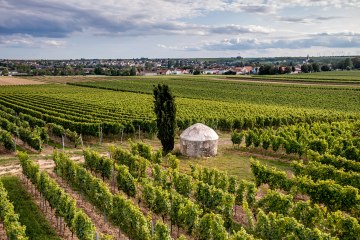
Once again the Middle High German: "Ule" means pot. The site was first mentioned in a document in 1382 with the name "an Ule erden". Why pot? Because potters found clay there. Today, the clay marl should stay where it is. And that is below the vines! Just as well as loess and limestone. Top Rieslings grow here: ripe aromas and fine exoticism on the nose; creamy and opulent on the palate. Due to the southern exposure, the grapes ripen early. Hikers enjoy the multitude of vineyard houses.
> From Wingertshäuschen to Wingertshäuschen: https://www.rheinhessen.de/wingertsheisje-wanderweg
> In 1834, winegrowing pioneer J.P. Bronner described the Aulerde and the Kirchspiel as the best vineyards in Westhofen. https://www.vdp.de/de/die-weine/weinbergonline/lage/8079-kirchspiel#map-inline-target
> Rheinhessen blog: https://blog.rheinhessen.de/wanderbericht-westhofener-wingertsheisjerweg-rebenmeer-kommandozentrale-und-ein-liebesnest/
> To the other single vineyard sites of Westhofen: Brunnenhäuschen, Kirchspiel, Morstein and Steingrube
How dexterous, the plough
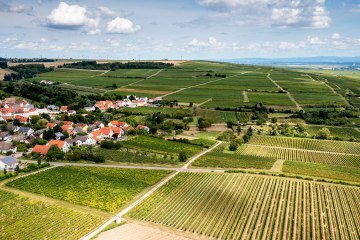
A Scandinavian custom in Rheinhessen? No, quite wrong. At the summer solstice, the sun is highest above the horizon at noon. But this fact and the Scandinavian festival have nothing whatsoever to do with the name. The location was first mentioned in a document in 1769 with the name "in der Sommerwindt". The name is based on a contraction of "Sommer" and "Anwende". Anwende" refers to the narrow side of the field where the plough is turned. A wide variety of grape varieties thrive on loess. Hangen-Weisheim, by the way, is abbreviated to "Ha-Wei" in Rheinhessen. Aloha!