
searchMenu
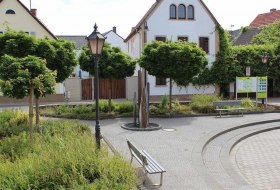

This defensive tower “die Schnecke” (the snail) controlled the former defensive wall, situated between the midle Altegässer and the now equally torn down Hammergässer Gate, (crossing: Unterer Zwerchweg/Mühlstraße). The weighty building from the end of the 14th century was still not roughcast in1900, so that the interesting construction of foundation and pointed cone roof can be easily recognised, a technique that can also be seen on the “Trulli” in the vineyards.
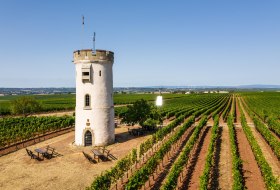
Above the town of Nierstein, located to the north in the Red Slope, lies the Wart Tower – the landmark of the town and one of the most beautiful viewpoints in the region. From here, an impressive panorama of the vineyards and the Rhine Valley opens up, extending to the Donnersberg, the Hessian Bergstraße, into the Taunus, as well as to Wiesbaden, Mainz, and the Rhine-Main area. Its origin dates back to a medieval signal tower from the 12th century. The stones from the demolished Kings Chair between Nierstein and Lörzweiler…

The Old Signal Box was built in 1899 at the intersection of the railway lines Alzey – Bingen and Alzey – Mainz. It was decommissioned in 2007. Today, train control is handled by electronic signal box technology. The Old Signal Box Armsheim Nord (An) is the only one of its kind (mechanical Stahmer signal box technology) in Rheinhessen, where all technical facilities of the block and lever systems, as well as the tensioning system, are completely preserved. Thus, visitors can closely experience how the work of a pointsman was until…
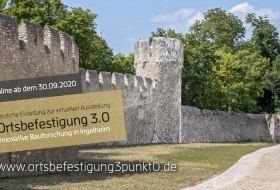
Local Fortifications 3.0 Innovative Building Research in Ingelheim Virtual exhibition on the town fortifications of Ober-Ingelheim and Großwinternheim The virtual exhibition Ortsbefestigung 3.0, Innovative Bauforschung in Ingelheim will be available on the website www.ortsbefestigung3punkt0.de from 30.09.2020! In the form of a 360° tour of the castle church, you will be informed on the one hand about two- and three-dimensional building survey methods, and on the other hand about new discoveries at the local fortifications…
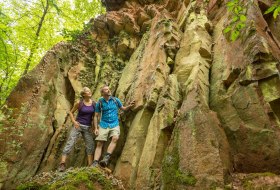
The sandstone quarries are typical for the region around Flonheim. In the past, they were used - as the name suggests - to extract sandstone, a popular building material.
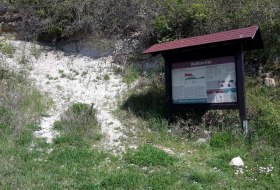
The soil profile is part of the Gau-Algesheim geoecological adventure trail. A soil outcrop and an information panel provide information about the formation of the Mainz Basin's calcareous tertiary.
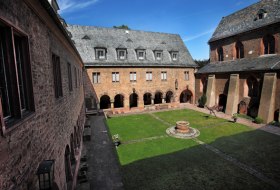
In one of the most beautiful buildings in Worms - the former Andreasstift, a late Romanesque building complex from the High Middle Ages - is the historical museum of the city. Through significant exhibits from Worms and its surroundings, we invite you on a journey of discovery through 7000 years of settlement history. In the two new cloister wings on the ground floor, the themes of city history, the history of the museum, and the model of the city are presented. On the upper floors, numerous interesting exhibits from the Neolithic,…