
searchMenu
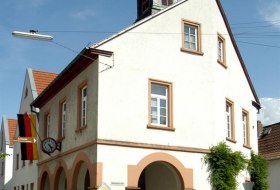
The town hall was built in 1832. In exchange for another site, the municipality of Monsheim received the building and the land from the Möllinger family. From then on, the house served as the town hall, and later the kitchen, the milk collection point and the fire brigade were also housed here. Today, meetings of the local council are held here, as well as the office hours of the local mayor. Text taken from Tour of Monsheim with kind permission.

On the way between the cemetery and the marketplace in Ulmengraben stands the Schiller monument with the Schiller lime tree. The pyramid-shaped monument with a bust was erected for the 100th birthday of the poet (1905), made from stones of the former prison. Wörrstädter Graben between the Evangelical Church and the marketplace in Wörrstadt.

Waldthausen Castle, a masterpiece of architecture in the heart of the Lenneberg Forest near Mainz, tells the story of a visionary builder, Martin Wilhelm von Waldthausen. In the midst of a 95-hectare area acquired by the municipality of Budenheim in 1908, the magnificent villa was built in 1910. The architectural design, executed by Hans Bühling, was inspired by Staufer palace buildings and continues to shape the estate today. The castle, in all its splendor, is surrounded by an extensive park and terraced gardens, which were once…
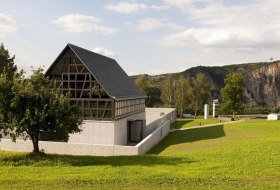
Bad Münster am Stein - Ebernbu
Not far from the mighty backdrop of the Rotenfels in Bad Münster am Stein-Ebernburg, the sculptors Kubach-Wilmsen built their open-air studio in 1968. Almost their entire life's work was created in this landscape. Since 2001 they have been transforming the abandoned vineyards into a stone sculpture park that is open to the public. A natural landscape in the Nahe valley opens up to the visitor and observer with stone sculptures as stone piece works of the earth. Nearly 30 sculptures have already found their place in this landscape. The…

Unique testimonies to Jewish life in Worms can still be seen today, including the Jewish Museum in the Rashi House. Step inside and learn about the long history of the building and the wide-ranging collection on the religion and everyday life of the Jewish community from the Middle Ages to the 20th century. New permanent exhibition ‘SchUm am Rhein - From the Middle Ages to the Modern Age’: The occasion for the exhibition is also the application for recognition of the SchUM sites of Speyer, Worms and Mainz as UNESCO World…
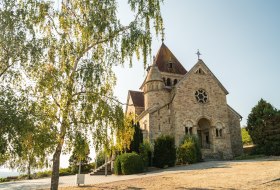
Gau-Bickelheim's landmark is the Chapel of the Cross, a sandstone building with a red tiled roof, which stands on the slope of the Wißberg. Built in 1755, the chapel was consecrated in honour of the Holy Cross and is a place of pilgrimage for many believers. The chapel was destroyed during the French Revolution. A new chapel was built between 1907 and 1910. Starting from Bahnhofstrasse, visitors pass 14 Stations of the Cross on their way to the Chapel of the Cross. Once at the top, there is a wonderful view over the Rheinhessen…

The former Rheingräflich von Salmsche court pharmacy was founded in 1728. The privilege to run a pharmacy was granted by the Raugraf von Salm to court pharmacist Friess. In 1790, the pharmacy was taken over by Dietrich Christ Dassel. The building was originally a baroque plaster construction and was renovated in a Gründerzeit style in 1886. Today, the pharmacy is owned by the Hohe family.
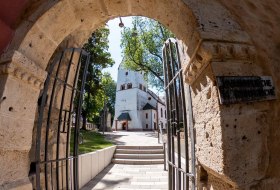
Discover the fascinating St. Martin's Church and its historic church garden in the heart of Nierstein. St. Martin's Church and its church garden are completely enclosed by a medieval defensive wall. The gate and tower at the Fronhof form the most striking entrance to St. Martin's Church and its garden, inviting visitors to take a stroll through the church garden, rest on one of the benches, pause for a moment, and reflect. The Romanesque choir tower from the 12th century is the oldest surviving part of the church. It has been altered…