
searchMenu

The crossing of the Rhine at Nierstein in 1945 by American troops was a key operation on the Western Front in the final phase of World War II. Starting from Nierstein, 18 km south of Mainz in what is now Rhineland-Palatinate, several hundred American infantrymen crossed the Rhine into southern Hesse and built bridges, which were then used to transport 60,000 vehicles for the further occupation of the German Reich. The operation went down in military history as the “Nierstein Crossing – Silent Crossing” because it took place…

300 years of Roman culture and history on the banks of the river Nahe! In a rustic ambience, the exhibition shows you excavation finds from a colossal palace villa from the Roman "cruciniacum", which once stood on the site of the museum. The exhibition presents the luxury of wealthy Romans on the Rhine border of the Roman Empire. At the centre are two magnificent mosaic floors (gladiator mosaic, Oceanus mosaic), images of gods, funerary monuments, glass art and everyday objects. Directly next to the Roman hall are the accessible and thus…

An diesem Aussichtspunkt mit Ruhebank hat man einen herrlichen Blick über den Rheingau bis zum Binger Loch.

On the fish market stands the heavy pressing stone (3820 kg), which was found after a fire in the opposing manor house of Baron von der Leyen-Uexküll. The weighing house serves as a reminder that here the grape carts and the "Wutz" were weighed.

In the immediate vicinity of the Deutschherrenhof on Hauptstraße (main street), a few hundred meters west of the Protestant church, is the New Leiningen Palace. The history of the Deutschherrenhof, a cultural monument, dates back to the 15th century. It originally belonged to the Lock family from Hangen-Wahlheim. At the beginning of the 16th century, the estate fell to the Teutonic Order and has been called Deutschherrenhof ever since. At the beginning of the 18th century, the old estate buildings were demolished and completely rebuilt.…

The 2.5 m high menhir likely dates from the Neolithic period (approx. 400 to 1700 BC). The menhir was discovered in 1927 during clearing work on the southeast slope of a rise near Dittelsheim-Heßloch at a depth of 80 cm and was re-erected 100 m away. It had probably been buried here in the late Middle Ages, but its name had persisted as a place name. Whether it originally served as a boundary stone, like many other menhirs, is unclear. It has a height of 210 cm, a width of 145 cm, and a depth of 80 cm.

Waldthausen Castle, a masterpiece of architecture in the heart of the Lenneberg Forest near Mainz, tells the story of a visionary builder, Martin Wilhelm von Waldthausen. In the midst of a 95-hectare area acquired by the municipality of Budenheim in 1908, the magnificent villa was built in 1910. The architectural design, executed by Hans Bühling, was inspired by Staufer palace buildings and continues to shape the estate today. The castle, in all its splendor, is surrounded by an extensive park and terraced gardens, which were once…
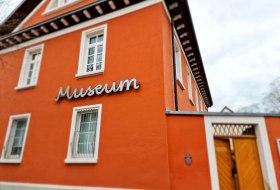
The Nackenheim Local Museum "MUXUM" conveys the history of the community of Nackenheim to visitors from different perspectives. In the "village treasury", the permanent presentation on the history of Nackenheim (ground floor), selected exhibits are displayed, each of which had a specific significance for the village and the region. A Q-code on the respective display case allows interested museum visitors to delve deeper into the history. The permanent exhibition "Nackenheim - the lower village shaped by the Rhine" (ground floor),…