
searchMenu

During the Reformation, Spiesheim had a parish church dedicated to Saint Stephen, which served the Reformed community as a place of worship until 1706. Due to the Palatine church division, the community lost its church and acquired a barn "Auf dem Liding," which was subsequently used for services. Initial plans for a new church were created in 1788, and a year later, the foundation work began. However, financial constraints, French occupation, two wars, and the integration of Rheinhessen into the Grand Duchy of Hesse-Darmstadt delayed…
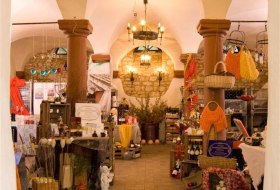
The cross vault in the Bernhard-Räder winery is used as a tasting and sales room for wines and other specialities such as brandies, various types of mustard and pesto. Always beautifully decorated, worth a visit! General information about Rheinhessen cow chapels The origin of the typical Rheinhessen vaults goes back to the early 19th century. At that time, farmers wanted to increase the yield of their cattle by keeping them in stables and use the leftovers as fertiliser for their fields. Initially, the cattle were housed on the…

Hinkelstein A Hinkelstein has been mentioned at this location since the 14th century. The original stone is very likely built into the dry stone wall. The current stone was erected in 2004 and originates from a foundation uncovered during sewer construction in Osthofen, alongside which Roman bricks were also found. Height: 188 District: "Am Hinkelstein" History / Stories / Anecdotes: A Hinkelstein has been mentioned here since around 1300. According to the Monzernheimer chronicler, teacher Georg Wendel, it was removed…

The church is the oldest building in the town. There was originally a wooden basilica here, which was mentioned as early as the 9th century, followed by a stone building from the 13th century. The choir with sacristy visible today dates from 1492 and the tower was built around 1520 as a defensive tower. The nave was expanded into three naves in 1911 based on Gothic styles.

A true natural monument is the over 370-year-old horse chestnut tree in the Ockenheim cemetery. With a trunk circumference of 5 meters and an impressive crown diameter of 25 meters, it is not only the oldest horse chestnut in Rheinhessen, but also one of the oldest in all of Germany. A true wonder of nature that you shouldn't miss!

With the Hildegard jubilee in 1998, the Historical Museum on the River - Hildegard von Bingen, the former electricity generating station on the bank of the Rhine River, opened its doors. There is a large department dedicated to Hildegard, the universal scholar and theologist. The museum offers something very special: a complete set of surgical instruments from the Roman days, discovered during renovation work in Bingen. A further department focuses on the Rhine Romantic epoch. In a unique way, the 200-year epoch is illustrated using, among…
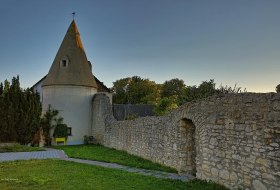
Along almost the whole length, the defensive wall, which runs parallel to Burgunderstraße, is still preserved, though on different heights. It follows the course of the defence moat, which was filled in last century, and runs in a straight line towards the west to the Stiegelgässer Tor. At about halfway this tower with a pointed roof, attached to a house, could be preserved.

Already in the 14th century, a ship's crane is evidenced at the Frei-Weinheimer bank. A first massive land crane was erected in 1549 after the model of the Binger crane (1487). The still visible foundation is a relic of the last crane powered by human labor, which was built around 1680. The rotating crane stand was embedded in the central shaft, to which the two tread wheels and the jib were attached. Two workers had to walk in the wheels to provide the drive for the system. Unloading and loading were subject to fees. The crane clerk kept a…