
searchMenu

In 2010, the Mainz patron Stefan Schmitz took over the now severely damaged ruins of St. Christoph. In 2012, the "Initiative St. Christoph" was founded, with the aim of restoring the dignity of the site with the help of public and private funds. Together with the city of Mainz, a restoration plan was created that aimed to complete the memorial in time for the 70th anniversary of its destruction on February 27, 2015. The plan was successfully implemented: The ruins, the tower, and the outdoor facilities were extensively renovated. Since 2015,…

The Protestant church in Dexheim looks back on an eventful history: Dexheim's St. Martin's Church was first mentioned in documents in 889; it was first referred to as “St. Martin's Parish Church” in 1341. During the Thirty Years' War and the subsequent War of the Palatinate Succession, it was almost completely destroyed, with only the church tower remaining intact. The church was gradually rebuilt. Major renovations took place in 1957 and 1958.
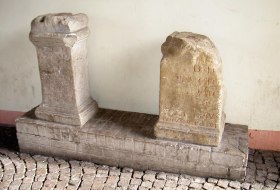
The cult of Mithras was brought to Mainz by Roman legionaries as early as the 2nd century. It was in direct competition with the emerging Christianity, as both religions showed some parallels. The underground sanctuaries, called Mithraea, consisted of elongated vaults with a Mithras altar at the end and were painted to resemble the starry sky. The followers of the cult therefore met underground, but symbolically under the canopy of heaven. The well-preserved altar is made of Odenwald marble. Its originally red inscription reads: “To…
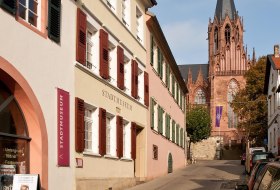
The Oppenheim City Museum offers a tour through the city's eventful and rich history—from prehistory to the end of World War II. It is the perfect addition to a visit with or without a tour guide. The ground floor displays artifacts and historical information from Roman times to the 17th century.

Juliusturm Built in the style of a medieval watchtower. Use of rubble stones, bricks, and baroque elements, including a boundary stone from 1600. The tower has a ground floor and a first floor, from which one can access the battlement via an iron ladder. After construction began in the spring of 1966, the inauguration took place on Ascension Day in 1971. The tower was renovated in 1999. It is named after its builder, Julius Grünewald. History / Stories / Anecdotes: As is well known, the…

The Oriental Heisje Here you can see a stout little house with a barrel roof, which was also commissioned by Unterfauth Hirschel in 1766. It consists of three walls, with the door opening facing south. The door frame is a special feature, as it hints at the shape of an onion tower. Height: 185 District: "Auf dem Staatsbühl" Place Names: 1382: off Stahelbohel 1399: an stahelbuhel 1400: uff dm Stahelsbuhel 1600: uf dem Staßbühel 1681: auff den Staasbühel 1934: Auf dem Staasbühl 1954: Auf dem…
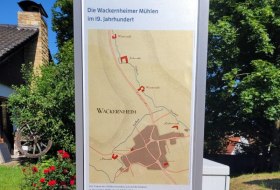
Where today the street "An der Bachwiese" runs, the mill stream used to flow. This was an artificially created watercourse, fed by the springs on the Neuberg and in the Großen Wiese. It powered the waterwheel of the Mitzmühle and then crossed the Hasselstraße. Beyond the Mühlstraße, it united with the Osterbach. The water power of this stream then served the mills of the three lower mills. Additionally, the water from the nearby springs was utilized. All Wackernheim mills were driven by overshot waterwheels. Until…

The Roman Theater in Mainz is one of the largest ancient stage buildings north of the Alps. Built presumably in the 1st century AD, it was located on the southern slope of the Kästrich, below the present-day citadel. With a stage width of about 42 meters and an audience diameter of 116 meters, the theater could accommodate around 10,000 visitors – an impressive scale that clearly illustrates the importance of Mogontiacum, Roman Mainz. Theaters of this kind were central places of public life in the Roman Empire and reflected the…