
searchMenu
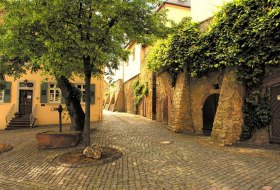
The cellar alley runs along the southern support wall of the marketplace. Here are the entrances to twelve vaulted cellars, which were already mentioned around 1600 and extend far beneath the marketplace. They are part of the once extensive and interconnected cellar system, another feature of the wine-growing village. Even today, some of the cellars are used for wine storage and can be visited during the annual cellar tour that takes place during the grape blossom festival.

The Roman Tower is a 9.8 m high observation tower built in 1998 in the vineyards northwest of Guntersblum. It is located directly on the RheinTerrassenWeg. 19 steps of an angled staircase at the back lead to the 5.6 m high covered viewing platform. From the platform, visitors have a very good view of the Rhine Valley, the Odenwald and Taunus and as far as Frankfurt, among other places. The Roman Tower is located near the place where a Roman Villa Rustica with a wine cellar was discovered a few years ago, thus pointing to the Roman past of…

With the 'Elevator to the Past', the former Hildegard Monastery becomes tangible Almost 400 years ago, the proud Monastery of Rupertsberg, the place where Hildegard of Bingen worked, was burned down in the Thirty Years' War and reduced to ruins. In 1803, the grounds were then transferred into private ownership. The monastery arcades were walled up. In the Villa Rupertsberg, starting from the original monastery arcades of the Hildegard Church, the disappeared Hildegard Monastery has been revived and can be discovered with all senses through…

Water House Built in 1905 in the Art Nouveau style for the water supply of Westhofen. In the 1960s, the pressure was no longer sufficient, and it was decommissioned. History and Stories Prominently visible, the water house from 1905, built in the Art Nouveau style, reflects the self-understanding of that era. Wilhelm II aspired to great power, rearmed, annexed land overseas, and constructed. The buildings always represented the thoughts of their respective time and their rulers; so does our water house,…

Here once stood the Catholic school building, which was built in 1857. Already in 1850, the Catholic priest of Heidesheim, Heinrich Berthes, had promised the church fund the donation of this property. It was to serve as housing for clergy, accommodation for the organist and the bell ringer, as well as a classroom for the Catholic confessional school. Until the introduction of communal schools, the Catholic teacher Josef Becker from Heidesheim lived and taught here. Afterwards, the house was rented out and finally auctioned off in 1896 to…

The Protestant church of Nieder-Saulheim was built between 1885 and 1886, after the previous building collapsed about 50 years earlier. It is a neo-Gothic hall with a transept and a recessed, vaulted choir. The comparatively tall, gable-crowned west tower has a square base and culminates in a classic helmet roof. Above the nave and the transept, wooden ribbed vaults rest on thin cast iron columns, while the extended side aisles feature transverse vaults and suspended galleries. Particularly worth seeing is a Gothic font from the 13th…

Culture at the Estate - the small arts stage at Weyell Winery looks back on a long family history. The large-framed farmhouse was built in 1713 and has been in the family since 1850. Here, not only winemaking is a tradition, but agriculture was also part of the Weyell family's activities. In 1995, a family member had the idea to use the large inner courtyard for an event, and thus the small arts stage was born. Whether cabaret, comedy, or live music - the offered program is diverse and also takes place in the winery's own vaulted cellar…

The viewpoint offers a beautiful view of the old quarry and its water surface. This is now an important retreat for the flora and fauna along the hiking trail. The lookout point is connected to the Hiwweltour Eichelberg via a short access path. There is a bench for resting.