
searchMenu

In 2010, the Mainz patron Stefan Schmitz took over the now severely damaged ruins of St. Christoph. In 2012, the "Initiative St. Christoph" was founded, with the aim of restoring the dignity of the site with the help of public and private funds. Together with the city of Mainz, a restoration plan was created that aimed to complete the memorial in time for the 70th anniversary of its destruction on February 27, 2015. The plan was successfully implemented: The ruins, the tower, and the outdoor facilities were extensively renovated. Since 2015,…

The clock tower in Oppenheim was built in 1843/44 on the remains of a former defensive tower of the medieval town fortifications in the neo-Gothic style. The tower is around 31 meters high and houses a viewing platform, among other things. The tower clock from 1907, which is still in working order, chimes the half and full hours. The building is maintained by the Friends of the Clock Tower in Oppenheim am Rhein and is a listed building. Further information can be found at www.uhrturm-oppenheim.de .

The Old Cemetery is located southeast of Stadecken-Elsheim and originally belonged to the abandoned village of Hedesheim, which was deserted in the 14th century when the residents settled closer to the newly built Stadeck Castle. The cemetery was still in use until 1804. Today, a small grove reminds visitors of its former location, and in front of it, a small rest area invites people to linger.

The bridge chapel in the land pier of the Drusus Bridge is probably the oldest preserved bridge chapel in Germany and the only underground one. The bridge chapel in the Drusus Bridge, 2021. Unfortunately, we do not have a current photo of the interior of the chapel in the city archive, hence this one from Wikipedia. Marion Halft: Early Romanesque bridge chapel under the Drusus Bridge, Bingen on the Rhine. CC-BY SA 4.0. Carved from the slate rock of the right bank of the Nahe, it lies on the axis of the Nahe Bridge 4.50 meters below the…

The Protestant church in Dexheim looks back on an eventful history: Dexheim's St. Martin's Church was first mentioned in documents in 889; it was first referred to as “St. Martin's Parish Church” in 1341. During the Thirty Years' War and the subsequent War of the Palatinate Succession, it was almost completely destroyed, with only the church tower remaining intact. The church was gradually rebuilt. Major renovations took place in 1957 and 1958.

The Bad Kreuznach Puppet Theater Museum presents a fascinating permanent exhibition on puppet theater culture worldwide and in Germany. Visitors experience the history of the Augsburg Puppet Box and the Salzburg Marionette Theater up close, from the carving workshop to the finished wooden head. The UNESCO-recognized puppet play traditions, from Chinese shadow figures to Sicilian knight marionettes, can be seen, and with 55 (!) interactive stations, the exhibition allows for SELF-EXPERIENCE, PARTICIPATION, or LISTENING. The PuK Museum will be…

On the outskirts of Kriegsheim, the dominant property of the Wiesenmühle farmstead rises with its prominent tower. The main building dates back to the 17th century and, together with the 3 large outbuildings, forms a closed, rectangular courtyard, which was acquired in 1816 by the Kriegsheim Mennonite Johann Mundorf. Since the transfer of ownership to the Schilling family in 1899, the main focus has been on arable farming. Viticulture is also a mainstay of the farm's agriculture. The mill itself is no longer in operation. In the "Old…
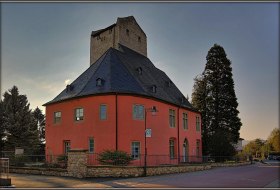
Windeck Castle in the centre of the district of Heidesheim was built by the knight Herdegen zu Winternheim in 1209 in the style of a tower castle with Gothic residential buildings. Originally, it was probably a moated castle with a moat and a curtain wall. Various owners used the castle as a residence, tannery and perforated mill, but also for religious services, before the municipality of Heidesheim am Rhein acquired it in 1993 with the aim of saving it from decay. Today, the building houses a community centre, a mayor's office and a wedding…