
searchMenu
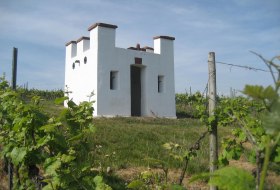
The Trullo - the Trulli - the special vineyard cottage in Rheinhessen. Former shelters in the vineyards for the workers, but also intended for the "Wingertschütz" who guarded the vineyards. This vineyard cottage stands out in the form.
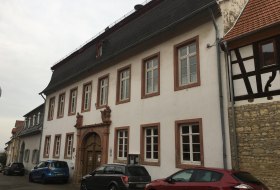
The Wamboldscher Hof is also worth seeing, a grand estate in the middle of the village that was built around 1770 in the Baroque style. Particularly striking are the wide entrance with pilasters and the mansard roof. After the French Revolution, this stately building served as a schoolhouse until 1963 and is now the parish house of the Evangelical Church Community of Partenheim. Visitation: By prior arrangement

Today, the house is a two-storey residential building and is considered the oldest house in the district of Dalsheim. Probably after the destruction in the Palatinate War of Succession in 1689, the building was renovated in 1716 according to the date above the door. The foundations, cellar and window jambs indicate that the building was originally built about 150 years earlier, in the 16th century. The upper storey is adorned all around with Franconian half-timbering, which was put back under plaster on the street side during the last…

A virtual 360° tour invites you to explore and gives you the opportunity to view the kING from a distance at any time. Further information on the event programme can be found here .
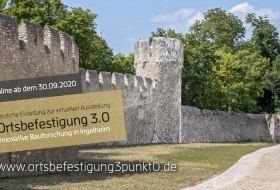
Local Fortifications 3.0 Innovative Building Research in Ingelheim Virtual exhibition on the town fortifications of Ober-Ingelheim and Großwinternheim The virtual exhibition Ortsbefestigung 3.0, Innovative Bauforschung in Ingelheim will be available on the website www.ortsbefestigung3punkt0.de from 30.09.2020! In the form of a 360° tour of the castle church, you will be informed on the one hand about two- and three-dimensional building survey methods, and on the other hand about new discoveries at the local fortifications…
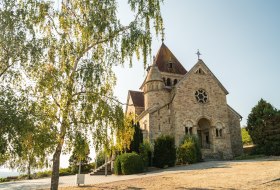
Gau-Bickelheim's landmark is the Chapel of the Cross, a sandstone building with a red tiled roof, which stands on the slope of the Wißberg. Built in 1755, the chapel was consecrated in honour of the Holy Cross and is a place of pilgrimage for many believers. The chapel was destroyed during the French Revolution. A new chapel was built between 1907 and 1910. Starting from Bahnhofstrasse, visitors pass 14 Stations of the Cross on their way to the Chapel of the Cross. Once at the top, there is a wonderful view over the Rheinhessen…

Along almost the whole length, the defensive wall, which runs parallel to Burgunderstraße, is still preserved, though on different heights. It follows the course of the defence moat, which was filled in last century, and runs in a straight line towards the west to the Stiegelgässer Tor. At about halfway this tower with a pointed roof, attached to a house, could be preserved.

The Mission Heisje Shelter house from the year 1766 Sturdy construction made of quarried stones with a barrel roof. In the 1980s, the Heisje was renovated and equipped with a concrete plaster. At the same time, the staircase and terrace were cast, and a railing was installed. Between 1983 and 2005, there was a "note mission" there: Believers could supply themselves from an open mailbox with Bible quotes and praises from the Marian Sisters from Darmstadt-Eberstadt. Can you find the two psalms that are still displayed on the…