
searchMenu
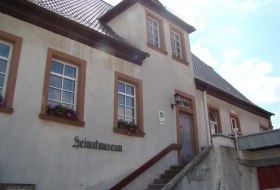
Built in 1741 as an administrative seat for the Greiffenclau district administrator in the area of the Pfalzhof. After being acquired by the municipality in 1853, it became a council and school house. Since 1984, it also serves as a local museum.

The Mennonite David Möllinger acquired the property at Hauptstr. 34 in 1744, later also the neighbouring farms and other land on a large scale. He practised arable farming, where he was able to contribute significantly to the abolition of three-field farming through fertilisation. He bred pigs and kept up to 40 fattened oxen. He grew grapes, distilled schnapps and brewed beer, which he stored in the cellar under the "Villa Fliedner". As a recognised economist, he became the purveyor to the court of the count of…
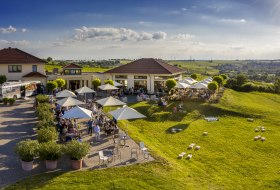
We, Anna and Stefan Raddeck, love wine and we want to share this passion with you. Since 2003, we have been working in a controlled ecological manner to preserve the excellent quality of our wines for future generations. Reducing yields, long maceration times, and partial spontaneous fermentation make our wines authentic and complex. This is especially true for our Rieslings from the renowned sites Schloss Schwabsburg, Heiligenbaum, Pettenthal, and Orbel from the Red Slope. Since 2009, the winery has been located in the middle of the…
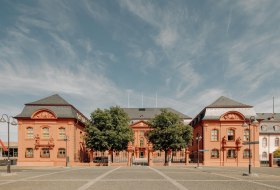
With its central location on the Rhine in the historic heart of Mainz, the Rhineland-Palatinate State Parliament is a special place both politically and architecturally. It resides in the traditional Deutschhaus, a magnificent Baroque building from the 18th century, which, after extensive restoration, combines modern parliamentary work with historical flair. As the seat of the Rhineland-Palatinate state parliament, the building represents lived democracy and the political history of the federal state. Visitors have the opportunity to get to…
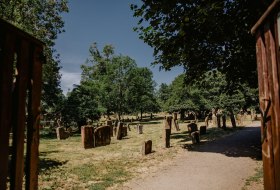
In July 2021, the cities of Worms, Speyer and Mainz were awarded the title of World Heritage Site by UNESCO for their ShUM sites. The cities are considered the cradle of Ashkenazi Judaism. Discover the Jewish monuments in Worms and their significance for the cultural heritage on this guided tour. You will visit the oldest preserved Jewish cemetery in situ in Europe, the ‘Holy Sand’, as well as the former Jewish quarter in the Judengasse with the synagogue. The monuments illustrate Jewish life in the city and, together with the…
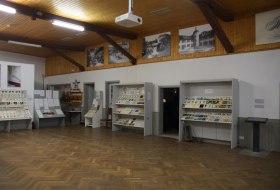
The Offstein Local History Museum's collection focuses on the history of the Offstein clay works and its tiles. The Art Nouveau tiles from the Offstein clay works are used in the Bad Nauheim Sprudelhof, among other places, which demonstrates their supra-regional significance and high artistic value. In addition, the museum collects and displays documents, media and objects relating to the history of the village and village life 30 and more years ago as a permanent exhibition. A complete shoemaker's workshop from this period deserves special…

Epitaph at the Windhäuser Hof in honor of Jeanbon Saint-André, created to commemorate his 200th anniversary of death in 2013. Jeanbon Saint-André served as General Commissioner of the four left bank Départements established in 1798 under Napoleon Bonaparte starting in 1801. From February 1802, he acted as the French prefect of the Département du Mont-Tonnerre based in Mainz. In 1809, he acquired the Windhäuser Hof, which he subsequently used as a summer residence.
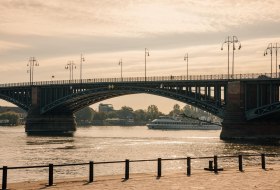
Since 1885, the Theodor-Heuss Bridge has connected Mainz with Kastel and spans the Rhine River. The distinctive steel arch construction shapes the city's skyline and is still considered one of the most important crossings over the river – for cars, cyclists, joggers, and walkers alike. Built near historic Rhine crossings such as the Roman bridge and the electoral prince's ship bridge, it continues a long tradition of cross-border connections. From early on, the bridge was more than just pure infrastructure: festivals and their symbolic…