
searchMenu

In the cross vault of the Engelthal Monastery fine seasonal dishes are offered. Matching every dish there are in-house wines. General information on this typical kind of Rheinhessen vault, called "Kuhkapelle" (cow chapel) The origin of the typical Rheinhessen vaults goes back to the early 19th century. At that time, farmers wanted to increase the yield of their cattle by keeping them in stables and use the leftovers as fertiliser for their fields. Initially, the cattle were housed on the ground floor of the half-timbered houses, above…

The construction of a forester's lodge in the second half of the 18th century is linked to the appointment of a kurfürstlichen forester. He was responsible for the entire Ingelheimer territory. The government aimed to combat the ongoing wood shortage with targeted reforestation. Sand dunes in the Nieder-Ingelheimer district were planted with pines. The wooded floodplains of the Rhine were managed. With the oversight of the planting of white mulberry trees to promote silk production, the forester received an important additional task…

Only a part of the entrance of the former Lutheran church building is still visible. The sandstone plaque above refers to the year of construction 1753. After both the Catholic and Reformed congregations had their own new houses of worship, the six resident Lutheran families joined forces with fellow believers from the Kurmainz Rheingau across the Rhine. With the help of a collection, a modest small church was built and used jointly. As the only church in Frei-Weinheim, it did not have a bell. The Lutherans were assigned to Ober-Ingelheim.…

Leiningen Castle, located in the town center, has a multifaceted past. The shell of the building was completed in 1708, but no further extensions were made at first as the owner at the time, Count Carl Ludwig von Leiningen-Dagsburg-Falkenburg, died in 1709. His wife, Countess Anna Sabina von Nostitz, sold the estate to the Electoral Palatinate Privy Council in 1717 due to financial hardship. In the years that followed, the castle fell more and more into oblivion until 70 years later, in 1787, a member of the Leiningen family once again became…
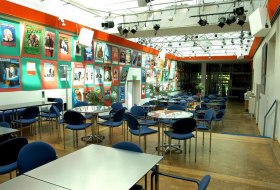
Since its founding in 1966, the Unterhaus in Mainz has been one of the most renowned venues for cabaret and small-scale arts in Germany. In the characteristic vaults of the stage, both established artists and emerging talents perform – always with the aim of creatively reflecting current events and moving the audience to laugh, think, and empathize. In addition to a versatile stage program, the Unterhaus is the annual host of the German Small Arts Prize, one of the most significant awards of its kind. This makes the theater not only a…
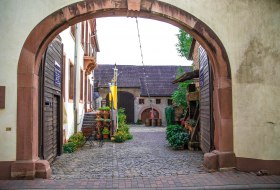
On the KulTOUR around the Nierstein market square, you can expect exciting stories about Nierstein's noble courtyards, underground secret passages and the old village smithy. The tour starts at the Haxthäuser Hof in Langgasse 35. All you need for this tour is a smartphone with a QR code scanner. Each building on the tour has a QR code with interesting facts behind it. A total of 16 stations invite you to get to know Nierstein better on your own. After the tour, you can stop off at one of the restaurants around the market square or start…

The Johanniterhof was first mentioned in a document in 1306. Parts of the building fabric are even older. After 500 years of belonging to the Order of St. John, the estate was divided into three manor farms under Napoleon. The former size of the entire complex is still clearly recognizable today.

Bad Münster am Stein-Ebernburg
The Rotenfels is a nature reserve and home to a variety of rare plants and animals found only here in the region. It is also an ideal place for hiking enthusiasts. One of many hiking trails leads directly along the entire rim of the rock massif. The Rotenfels lies on the left bank of the Nahe River between the villages Norheim and Bad Münster am Stein-Ebernburg. The south-south-eastern border is defined by the Nahe Wine Route running at the foot of the slope and the outskirts of Bad Münster am Stein-Ebernburg. In the southwestern…