
searchMenu

The estate of Eckhard and Hildegund Müller is a half-timbered house from the year 1748. As early as 1720, the property, which then belonged to Jakob Jakobs from Ensheim, contained a dilapidated residential house, a support barn, an old, crumbling stable, and a wine press. In the following years, the estate changed hands multiple times: After Petri, Zengerle, and Steil, Peter Keller acquired it from Konrad Mann at auction. Until 1823, Andreas Mayerhöfer is named as the owner, followed by Philipp Schmitt I in 1831, Heinrich Schmitt…

The farm shop offers a selection of freshly harvested as well as storable fruits. Which fruits are currently ripe can be seen at any time on the homepage. In addition, the range includes numerous products made with care from our own production, including jams, jellies, syrups, juices, pure apple juices, spirits, strawberry punch, and fruit secco. The offering is complemented by selected products from local farmers. Right next to the farm shop is a self-service booth that allows for the purchase of selected products even outside regular…

The present property "Alte Schmiede Wettig" was a forge workshop from 1776. The workshop with its equipment and tools is still in its original state of the 1920s. The barn and stables offer space for exhibitions, music, literature and theme evenings.

The column illustrates the coexistence of Roman and Germanic cults: 28 reliefs depict Roman and Celtic deities. Currently, the copy of the Jupiter column has been dismantled due to stability issues and is now being restored in sections. The original can be seen in the State Museum.

The wine table is a popular resting place in Rheinhessen. With a length of five meters, it offers even larger groups the ideal opportunity to take a break together. The wine tables are always located at particularly beautiful spots in Rheinhessen. The wine table at the Hiwweltour Heideblick is situated in the vineyard "Goldenes Horn" in the district of Siefersheim. From April to October, the wine sale of IG Biggsestick.komm takes place here regularly.

The 2.5 m high menhir likely dates from the Neolithic period (approx. 400 to 1700 BC). The menhir was discovered in 1927 during clearing work on the southeast slope of a rise near Dittelsheim-Heßloch at a depth of 80 cm and was re-erected 100 m away. It had probably been buried here in the late Middle Ages, but its name had persisted as a place name. Whether it originally served as a boundary stone, like many other menhirs, is unclear. It has a height of 210 cm, a width of 145 cm, and a depth of 80 cm.
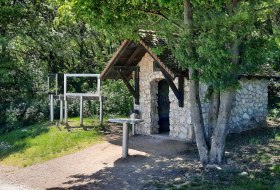
The Falkenberghütte, located above Dienheim, offers hikers along the RheinTerrassenWeg the opportunity to take a break. The hut, donated by the Dienheim Reconstruction Community, invites for a well-deserved rest after an eventful hike through the beautiful landscape. Two large panoramic windows reveal a fascinating panorama that opens up the view towards the historic Oppenheim and the charming Dienheim. The gentle hills of Rheinhessen with their picturesque vineyards provide a dreamy backdrop for beautiful photo motifs.

With the Hildegard jubilee in 1998, the Historical Museum on the River - Hildegard von Bingen, the former electricity generating station on the bank of the Rhine River, opened its doors. There is a large department dedicated to Hildegard, the universal scholar and theologist. The museum offers something very special: a complete set of surgical instruments from the Roman days, discovered during renovation work in Bingen. A further department focuses on the Rhine Romantic epoch. In a unique way, the 200-year epoch is illustrated using, among…