
searchMenu

The Old Cemetery is located southeast of Stadecken-Elsheim and originally belonged to the abandoned village of Hedesheim, which was deserted in the 14th century when the residents settled closer to the newly built Stadeck Castle. The cemetery was still in use until 1804. Today, a small grove reminds visitors of its former location, and in front of it, a small rest area invites people to linger.

The Wine Village Museum in Horrweiler is located in the old centre of the village, opposite the "Alte Kelter". Interested visitors can gain a comprehensive insight into village life in past centuries. In the entrance area, the imposing striking mechanism of the Horrweiler tower clock can be marvelled at and is a particular attraction for those interested in technology. A large part of the exhibition is dedicated to winegrowing from bygone times with various tools. On the upper floor, we immerse ourselves in the classroom from earlier times;…

Shaped from fire and water: The Goose Rock Formation From the Salinental, one looks eastwards to a rock formation that looks like a huge slagheap. This was given its name in Celtic times: "Ganda", i.e. steep slope with rock debris. Elementary forces have shaped the goose. 280 million years ago, magma came to the surface from the earth's interior, solidified and formed a rock massif to which both Rotenfels and Rheingrafenstein belong. The Nahe - Celtic "Nawa" - carved its way into this rock and dug its way deeper and deeper into it. This is…

The tower built around the year 1000 and the old silent organ from 1784, along with the beautiful stained glass windows and a wing altar, provide a successful cross-section through different eras. During the Thirty Years' War and also in the War of the Palatine Succession, the church, regarded as the main fortification of the village, was heavily damaged and partially destroyed. In 1706, it was assigned to the Protestants, who renovated it with a flat ceiling in 1725. Even after several renovations, the overall structure of today's church…
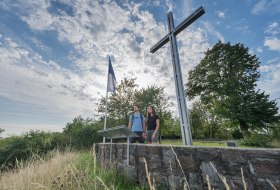
If you want to discover the region from a different perspective, the "Balcony of Rheinhessen" is the perfect spot. This viewpoint offers breathtaking views of the Rhine Valley and the Donnersberg. Here, you can immerse yourself in the vastness of the region - ideal for a moment of relaxation in the heart of nature. On clear days, the view even extends to the Taunus!
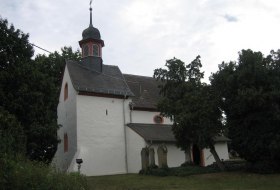
The protestant parish church St. Georg is the church of the deceased village Sarlesheim. It was abandoned after the village Neu-Bamberg was built at the foot of the castle. Only the church remained. It was already mentioned in 1522 as the parish church of Neu-Bamberg. The core of the church still dates back to the Middle Ages. Modifications and extensions followed in the 18th century. The stone former altar canopy dates back to 1516.

The construction of a forester's lodge in the second half of the 18th century is linked to the appointment of a kurfürstlichen forester. He was responsible for the entire Ingelheimer territory. The government aimed to combat the ongoing wood shortage with targeted reforestation. Sand dunes in the Nieder-Ingelheimer district were planted with pines. The wooded floodplains of the Rhine were managed. With the oversight of the planting of white mulberry trees to promote silk production, the forester received an important additional task…

The existence of the Protestant church in Dorn-Dürkheim can be reliably traced back to 1245, although the original building was probably constructed almost 400 years earlier. The current building dates mainly from 1618. The church building is a rectangular hall structure and some of the choir walls are still Gothic. Particularly impressive is the originally free-standing tower on the north side, which brings a piece of history to life with its embrasures – without any division into floors.