
searchMenu

The access to the fountain path is hidden at the far end of this square. If you follow the narrow path to the left, the fountain path leads close to the narrow buildings along the Zuckerberg area. The origin of the name "Brunnenpfad" is unknown. Presumably it was a path the residents used to reach wells outside the fortified defensive walls. The so-called health fountain is also located at this circular route station. A staircase leads to the spring water, which gushes 4 meters below the surface, which used to be routed through a brick…

The Protestant church was built in 1910 in the Art Nouveau style, after the formerly Reformed church on Kirchstraße, dating back to 1739, had become too small and dilapidated. It is named after King Gustav II. Adolf, who entered the Thirty Years' War as a Protestant military leader of the Swedes in 1630. His likeness is depicted in a stained glass window on the west side. For four years, starting from the winter of 1631/32, the Swedes ruled over Ingelheimer Grund after they had expelled the Spanish occupation. The construction of the…

In 2017, the Saubachtal, named after the Saubach, was extensively renatured. Thanks to several created ponds, the Saubachtal offers an ideal retreat for animals and plants. A rest area with a quiet bench invites you to linger in the most beautiful spot.
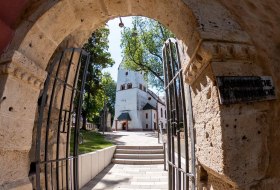
Discover the fascinating St. Martin's Church and its historic church garden in the heart of Nierstein. St. Martin's Church and its church garden are completely enclosed by a medieval defensive wall. The gate and tower at the Fronhof form the most striking entrance to St. Martin's Church and its garden, inviting visitors to take a stroll through the church garden, rest on one of the benches, pause for a moment, and reflect. The Romanesque choir tower from the 12th century is the oldest surviving part of the church. It has been altered…

The Nachtigallenhof in Wallertheim is primarily a large perennial garden (18,000 square metres) with site-appropriate plantings that cope well with the summer-dry climate. Orchards with species-appropriate poultry husbandry and a kitchen garden complete the picture. We offer guided tours for visitors and visitor groups by appointment. Of course, you can also visit the garden without a guided tour. Spend a few inspiring hours with us and stroll through the near-natural plantings (admission for garden visit 5 euros per person). Our small…

On a circular route through the vineyards around Alzey, the art and culture trail takes you past interesting works of art and picturesque vineyard cottages. Enjoy the view over Alzey. Guided tours can be found at www.alzeyer-land.de. Of course, you can also explore the trail on your own. You can download or order the flyer with directions and explanations of the works of art from our homepage .

The Gigser is the local mountain of the municipality of Wolfsheim. The vantage point is about 1 km outside the local community and offers wonderful views of the surrounding area. A refuge, a Wingerts swing, a lounger and a few tables and benches are inviting for a rest. In addition, there are two "tables of wine" below the gigser. In summer, the Gigser is hosted by Wolfsheim wineries and clubs on the afternoon of the 3rd Sunday of each month. Since 2017, the refuge at the Gigser has been a branch of the registry office of the VG…

The stone was erected around 1832 and commemorates the construction of the "Ingelheimer Grundstraße" (1829-1832), which here to the west of Stadecken intersected the country road from Mainz to Bad Kreuznach over Sprendlingen.