
searchMenu

The Roman Tower is a 9.8 m high observation tower built in 1998 in the vineyards northwest of Guntersblum. It is located directly on the RheinTerrassenWeg. 19 steps of an angled staircase at the back lead to the 5.6 m high covered viewing platform. From the platform, visitors have a very good view of the Rhine Valley, the Odenwald and Taunus and as far as Frankfurt, among other places. The Roman Tower is located near the place where a Roman Villa Rustica with a wine cellar was discovered a few years ago, thus pointing to the Roman past of…

Multimedia offer guides you through the imperial palace of Ingelheim! The Kaiserpfalz App is available free of charge at Google Play and in the AppStore (to be found under the keyword "Kaiserpfalz Ingelheim"). The app supplements the signage and accompanying booklet with a digital guide through the Kaiserpfalz region, which provides audio texts and picture galleries, among other things. Thus, the Kaiserpfalz can be experienced digitally at any place and at any time.

Above the castle, on the walled former cemetery, stands the evangelical church of St. Peter, which originally served as a fortified church. Castle and church used to be connected by an underground passage. When the Romanesque church was destroyed by fire in 1435, the tabernacle with the hosts inside miraculously remained intact. This so-called "Miracle of the Host" gave rise to pilgrimages. The new church was completed in late Gothic style at the end of the 15th century. With its old paintings and grave commemorative plaques, it is an…

The sulfur spring is located in immediate proximity to the barbecue area. Sulfurous water flows from it.
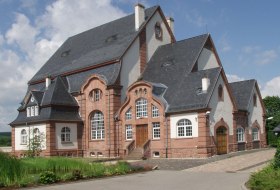
To secure the water supply in the Rhine-Selz region, the “Rhine-Selz Region Water Association” was founded in 1905. Due to the favorable local conditions, the necessary water extraction and supply was to be carried out from Guntersblum. It was therefore decided to build a waterworks with pumping facilities on site. Construction began in May 1906, and after a relatively short construction period, the facility was inaugurated in October 1907. The waterworks was built from red Palatinate sandstone in a Baroque Art Nouveau style and…

Somewhat hidden behind the café and directly next to the Drusus Stone on the Citadel lies the City Historical Museum in Building D – opened in 2003, but still almost a insider tip. The museum is a private institution and is funded by membership fees, donations, and entrance fees. The sponsor is the Mainz City Historical Museum Association, which was founded in 1996. The museum offers a comprehensive overview of the history of the city of Mainz, but places a particular emphasis on social and economic historical aspects. Exhibits…
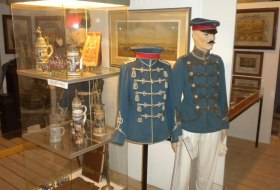
The collection at the "Museum Storage of the Fortress and Garrison Mainz" showcases uniforms, photos, documents, and memorabilia that vividly illustrate the garrison history of the city. Particularly noteworthy is a detailed model of the Mainz fortress. All exhibits were acquired and lovingly arranged by Wolfgang Balzer with great effort. The museum is generally accessible to all visitors, although prior registration is required. During guided tours, Wolfgang Balzer provides an exceptionally educational and entertaining introduction to the…

The central attraction of the Rochusberg is the pilgrimage church of St. Rochus, built in 1895 in neo-Gothic style. The first chapel was built on this site in 1666. The Rochus pilgrimage with Rochus festival also goes back to this time. A special feature is the Hildegard and Rupertus altar from 1895: The Hildegard altar shows scenes from the lives of the saints (outside of the service times only the church vestibule is open). In the Hildegard Forum of the Sisters of the Cross, exhibitions, lectures and seminars deal with the saint. A…