
searchMenu

The impressive choir is mainly preserved from the church built around 1330 for the Antoniters. The church is one of the three remaining Gothic monastery churches in Mainz, alongside the Carmelite and the Reichsklaren churches. From 1620 until the secularization in 1802, it served the Poor Clares. The single-naved choir has a complete cycle of paintings from the time of construction – the only one of its kind in Mainz. The paintings uncovered in 1948 were completed, allowing the cohesive overall picture to convey the original spatial…

A grid gate leads to the grounds of the modern Jewish cemetery. This was established at the latest in the 18th century in the former bastion, a strip only five meters wide next to the Aula regia. Presumably, the majority of the graves date from the 19th century; however, due to the severe weathering of the gravestones, a precise dating is no longer possible. After the Nazi takeover, the Jewish cemetery was expropriated in 1935. All 25 gravestones were relocated to the Jewish cemetery in Ober-Ingelheim. During the redesign of the access to…
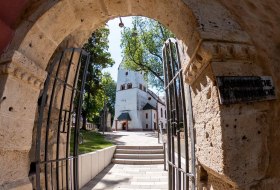
Discover the fascinating St. Martin's Church and its historic church garden in the heart of Nierstein. St. Martin's Church and its church garden are completely enclosed by a medieval defensive wall. The gate and tower at the Fronhof form the most striking entrance to St. Martin's Church and its garden, inviting visitors to take a stroll through the church garden, rest on one of the benches, pause for a moment, and reflect. The Romanesque choir tower from the 12th century is the oldest surviving part of the church. It has been altered…

With the proceeds from the house at Aschaffenberg, Gutenberg's cousin Arnold Gelthus co-signed for the start-up financing of the printing workshop in Humbrechthof. Today, it is the oldest half-timbered house in Mainz, located in the picturesque Kirschgarten - right in the heart of the charming old town.

The medieval cemetery "Judensand" on Mombacher Straße is largely preserved. Time and again, expulsions of the Jewish community led to clearances and alterations, causing many gravestones to be lost. Since the 1860s, significant gravestones of Jewish origin have repeatedly surfaced during construction work in Mainz. In 1926, Rabbis Levi and Salfeld united prominent gravestones to create a memorial cemetery, in order to make the Jewish heritage visible and emphasize the community's location in Magenza and Germany. The oldest preserved…

The oldest Jewish cemetery in Europe has around 2,000 graves, the oldest gravestone dates from around 1058/1059 and is part of the UNESCO World Heritage SchUM Sites Speyer, Worms, Mainz - Jewish Heritage for the World. From the part on the former city rampart you have an impressive view of the cathedral, the so-called "Martin Buber View". The old Jewish cemetery "Heiliger Sand" is still of great importance to Jews worldwide. Numerous influential Jewish scholars and rabbis were buried here. The oldest gravestones date back to 1058/59 and thus…

The 2.5 m high menhir likely dates from the Neolithic period (approx. 400 to 1700 BC). The menhir was discovered in 1927 during clearing work on the southeast slope of a rise near Dittelsheim-Heßloch at a depth of 80 cm and was re-erected 100 m away. It had probably been buried here in the late Middle Ages, but its name had persisted as a place name. Whether it originally served as a boundary stone, like many other menhirs, is unclear. It has a height of 210 cm, a width of 145 cm, and a depth of 80 cm.

On a circular route through the vineyards around Alzey, the art and culture trail takes you past interesting works of art and picturesque vineyard cottages. Enjoy the view over Alzey. Guided tours can be found at www.alzeyer-land.de. Of course, you can also explore the trail on your own. You can download or order the flyer with directions and explanations of the works of art from our homepage .