
searchMenu

The Carnival Fountain, also known as the Fasnacht Fountain, rises almost nine meters high on Schillerplatz in Mainz and was completed in 1967. It features over 200 bronze figures, including Till Eulenspiegel, Father Rhine, and Hans Wurst, embodying the spirit and myth of Mainz's Fastnacht – including the famous "Weck, Worscht und Woi." From the balcony of the Osteiner Hof, the greats of Mainz's Fastnacht officially open the Carnival season each year on November 11. Although Mainz had long been known for its fifth season, the city…

A mysterious atmosphere envelops the nighttime Mainz of Roman times. Soldiers in full armor gather around the fire of a large pyre, laying down weapons and spoils, while wails of mourning echo through the darkness and the flickering fire casts ghostly shadows on the nearby memorial. This could have looked like the annual death cult for General Drusus. Remains of the Drusus stone, regarded as an important Roman monument, can still be seen today on the grounds of the citadel. Nero Claudius Drusus, known simply as Drusus, was a stepson of…

The cabaret stage Oberhaus is a cultural highlight of the city centre in Alzey and offers a diverse program for every taste. No matter if it's comedy, cabaret or a live band, the stage offers enough space for every kind of art. Apart from that the visitors can take part in whiskey tastings after their registration or they can prove their skills at a darts competition. Also there are parties in the Oberhaus on a regular basis. The counter is with a length of ten meters one of the longest in Alzey, the musical entertainment is diverse, they…

The menhirs date back to prehistoric times. Of the once larger group, three are still preserved today. The well-known "Hinkelstein" is still located near its original site at the southern edge of the village. The other two stones, the "Dicke Stein" and the "Spitze Stein," were moved during land consolidation and are now situated on a property near the Wiesbach Bridge on Bahnhofstraße. The "Dicke Stein" has been re-erected there, while the "Spitze Stein," which is broken into two pieces, lies on the ground a few meters away. A…

At the municipal cemetery, on the way to the village ditch (along the Evangelical church), there are gravestones from the 17th and 18th centuries. Among them are early classical tombstones. Between the funeral hall and the Catholic rectory stands a stone column crowned with an ancient helmet, a plate with flags, and a broken cannon. The memorial was erected for the soldiers from the canton of Wörrstadt who returned from or fell in the Napoleonic campaigns.

Discover the Protestant parish church of Undenheim, a small country church with a fascinating history. Over the years, it has been redesigned time and again, giving it its cozy charm and making it a special place. During the renovation work in 1926–1927, the impressive mural behind the altar depicting Jesus Christ was created. This work of art was created by Otto Linnemann, a well-known artist from Frankfurt am Main, and still characterizes the interior of the church today. The organ inside dates back to 1905 and was built by the…

The Flute Player Fountain was inaugurated on 5 May 1990 with a village festival attended by a large number of people. It is a bronze sculpture by Grustav Nonnenmacher, an outstanding formative artist from Worms who has created numerous works. Nonnenmacher integrated one of the old sandstone troughs donated by Kurt Bernhard into the fountain. The flute player symbolises the cheerfulness of the people of Rheinhessen who live here. A boy as a musician, warbling into the air, legs crossed, content with himself and the world. The fountain was…
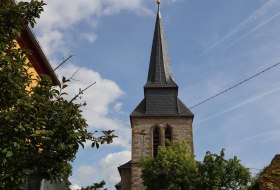
After centuries of use as a simultaneous church by the neighbouring Catholic Church, the foundation stone for the Protestant Church in Friesenheim was laid in 1885. After just over a year of construction under the supervision of architect Professor Heinrich von Schmidt from Munich, the church was consecrated in 1886. While the exterior walls of the building are made of Oppenheim limestone in a square shape, Dexheim limestone was used for the interior walls. The rest of the interior was designed with Flonheim sandstone. The windows, designed…