
searchMenu
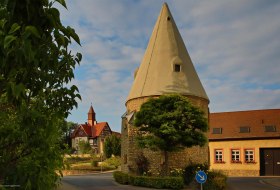
According to historical maps, this round and two storey fortified tower with a pointed stone cone shaped roof was to the south-east of the old defences. The former eastward section of the wall led, across the later Neuweg, towards the Uffhubtor. The tower dates from the first half of the 15th century. This style of tower is most frequent in Ober-Ingelheim. In the 19th century they were often transformed to condominiums.
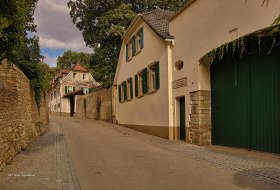
The lower part of Stiegelgasse and Edelgasse form one of the early cores of Ober-Ingelheim’s settlement. Here a significant number of aristocratic estates were concentrated. Most were singular farmsteads surrounded by large gardens or parks. The estate Stiegelgasse 65 with the Bodepark once belonged to the von Beuser family, one of the two sidelines of an early mentioned old Ingelheim kin of nobles. Around 1837, on this site, the estate of the wine and vinegar merchant Philipp August Gerhard was created, using old foundations. The…
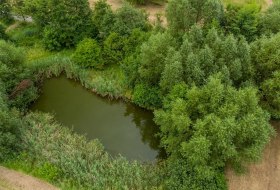
The Rohrwiesen biotope can be seen from far away on the Hiwweltour Zornheimer Berg. The many species in the biotope welcome hikers with an intensive natural background noise, which only decreases when the Hiwweltour passes into the vineyards.
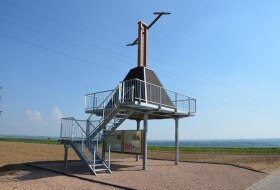
Non-historical replica of the 21st (penultimate) telegraph station, which was built in 1813 between Elsheim, Schwabenheim, and Wackernheim to complete the network of the then-new telegraphy between Metz and the then-French Mainz. Reconstruction in 2016, funded by LEADER funds. Contribution from the local community of Stadecken-Elsheim to the 200th anniversary of Rheinhessen. Text provided by the local community of Stadecken-Elsheim.
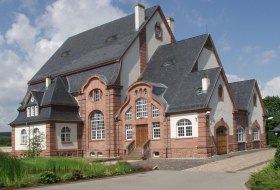
To secure the water supply in the Rhine-Selz region, the “Rhine-Selz Region Water Association” was founded in 1905. Due to the favorable local conditions, the necessary water extraction and supply was to be carried out from Guntersblum. It was therefore decided to build a waterworks with pumping facilities on site. Construction began in May 1906, and after a relatively short construction period, the facility was inaugurated in October 1907. The waterworks was built from red Palatinate sandstone in a Baroque Art Nouveau style and…
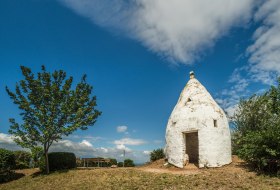
A special feature among the vineyard cottages, which served as shelters for farmers and winegrowers throughout Rheinhessen, are the trulli. Like white sugar loaves, they shine between the rows of vines. Three of them can be found in the region around Flonheim. The name comes from the roundhouses that are mainly found in Apulia/Italy. In our region they were built in the 18th century as shelters in the vineyards, although there is no historical evidence as to whether the round houses from Puglia served as a model or not. One of the most…
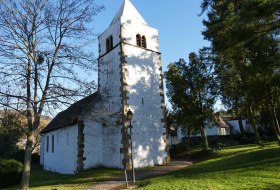
Bad Münster am Stein - Ebernbu
Surrounded by shady trees, the Old Johanneskirche, the oldest preserved building in the district of Ebernburg and indeed the entire city, stands in the cemetery. The whitewashed church was built before the year 1200 and was first mentioned in writing in 1212. Its location between the hill of Ebernburg and the massive porphyry masses of the Rotenfels gives the place a particularly romantic aura. The church was part of the city wall, which is why it was called a fortified church. The marked feature is the pyramid-shaped roof of the square…
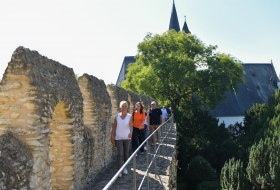
The all-around accessible main wall was mainly constructed in the 15th century. Its most vulnerable flank at the Mainzer Berg was strengthened by the addition of a Zwinger (inner defence gate). The only entrance (at Grabengasse/Kirchgasse) received an outer gate, a so-called “Barbarkane”. The second, southern breach was created in 1873 and provided access to the vineyards. The most salient point is the so-called Malakoff tower - formerly the “Alte Wache” (old guard post) with its dungeon. It offers an impressive…