
searchMenu
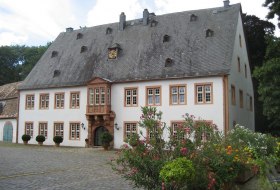
First mentioned in the 14th century as the moated castle "Veste Monsheim". The present castle complex was built in 1651 by the "Lords of Wachenheim". From 1780 to 1852, the estate was owned by the von Gagern family. Heinrich von Gagern, the president of the National Assembly of 1848, was the most important resident. Later, the castle was owned by the Baron von Heyl zu Herrnsheim, and the Knauff ladies' riding school was also located here. The Monsheim Hinkelstein, one of the largest monoliths in Rheinhessen, stands in the courtyard. Today the…
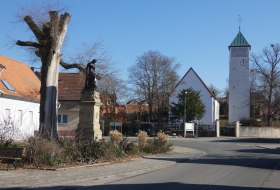
St. George's Church in the center of Dalheim was completed in 1611 and renovated in 2013. It dominates the townscape and is the symbol of the community.

The Rotenfels is a nature reserve and home to a variety of rare plants and animals found only here in the region. It is also an ideal place for hiking enthusiasts. One of many hiking trails leads directly along the entire rim of the rock massif. The Rotenfels lies on the left bank of the Nahe River between the villages Norheim and Bad Münster am Stein-Ebernburg. The south-south-eastern border is defined by the Nahe Wine Route running at the foot of the slope and the outskirts of Bad Münster am Stein-Ebernburg. In the southwestern…
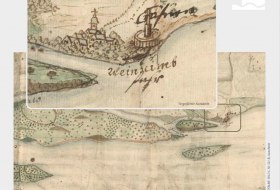
The ferry service to Mittelheim was first documented in 1348. During the Kurpfalz era, there was a regular ferry service operated by the Weinheimer Fahrgemeinschaft. The entire village was involved. There were two flat ferries for transporting vehicles and a small boat for passengers. Six men went on Fahr daily. At sunrise, three ferrymen crossed the Rhine and remained in Mittelheim, so that there was always a ferry available at each riverbank. The fee for the crossing was received by the ferrymen as wages. A sailmaster collected a weekly…
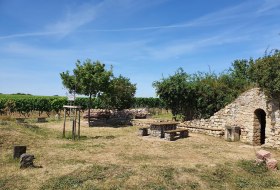
The vineyard cottage, estimated to be around 150 years old, was awarded a prize by the Rheinhessen Wine Brotherhood in 2015 after being expertly restored and refurbished by dedicated citizens of Uelversheim. A lovingly designed outdoor area provides opportunities to relax and linger. The earth-covered barrel-vaulted rectangular building of the Graunsberghäuschen invites visitors to sit down on a brick bench that runs around the interior. On the K41 road to Oppenheim on the left-hand side (second dirt road before the farmstead), a paved…

Pastry shop, café, confectionery Our master confectioner Christine Jung surprises you every day with fresh delicacies from our confectionery. Are you still looking for a "souvenir"? Then we recommend our handmade chocolate specialities.
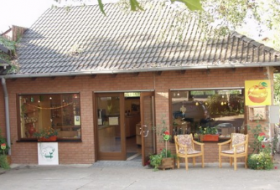
The farm shop offers a selection of freshly harvested as well as storable fruits. Which fruits are currently ripe can be seen at any time on the homepage. In addition, the range includes numerous products made with care from our own production, including jams, jellies, syrups, juices, pure apple juices, spirits, strawberry punch, and fruit secco. The offering is complemented by selected products from local farmers. Right next to the farm shop is a self-service booth that allows for the purchase of selected products even outside regular…
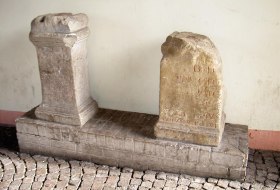
The cult of Mithras was brought to Mainz by Roman legionaries as early as the 2nd century. It was in direct competition with the emerging Christianity, as both religions showed some parallels. The underground sanctuaries, called Mithraea, consisted of elongated vaults with a Mithras altar at the end and were painted to resemble the starry sky. The followers of the cult therefore met underground, but symbolically under the canopy of heaven. The well-preserved altar is made of Odenwald marble. Its originally red inscription reads: “To…