
searchMenu
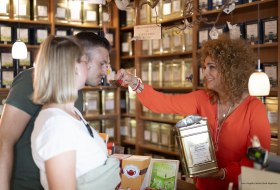
The Teekännchen, the special feel-good oasis in the heart of Ingelheim, enchants with its appealing, homely atmosphere and unusual variety of products, coffee specialities, over 400 types of tea, handmade waffles and cakes, decorative or gift articles, tableware and much more. Let us inspire you too!
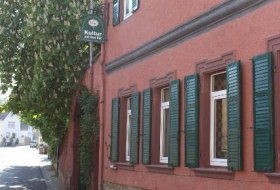
Culture at the Estate - the small arts stage at Weyell Winery looks back on a long family history. The large-framed farmhouse was built in 1713 and has been in the family since 1850. Here, not only winemaking is a tradition, but agriculture was also part of the Weyell family's activities. In 1995, a family member had the idea to use the large inner courtyard for an event, and thus the small arts stage was born. Whether cabaret, comedy, or live music - the offered program is diverse and also takes place in the winery's own vaulted cellar…
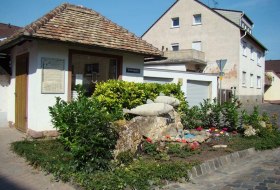
On the fish market stands the heavy pressing stone (3820 kg), which was found after a fire in the opposing manor house of Baron von der Leyen-Uexküll. The weighing house serves as a reminder that here the grape carts and the "Wutz" were weighed.

The Mission Heisje Shelter house from the year 1766 Sturdy construction made of quarried stones with a barrel roof. In the 1980s, the Heisje was renovated and equipped with a concrete plaster. At the same time, the staircase and terrace were cast, and a railing was installed. Between 1983 and 2005, there was a "note mission" there: Believers could supply themselves from an open mailbox with Bible quotes and praises from the Marian Sisters from Darmstadt-Eberstadt. Can you find the two psalms that are still displayed on the…

The sculpture ‘Die Wolke’ (The Cloud, 1968/69, bronze) by Eberhard Linke at the starting point of the Hiwweltour Aulheimer Tal is a reference to the sculpture collection of the Eberhard and Barbara Linke Foundation. The sculptures can be viewed from May to October, Saturdays from 2 pm to 6 pm. Address: Erbes-Büdesheimer Straße 7, 55237 Flonheim Admission free
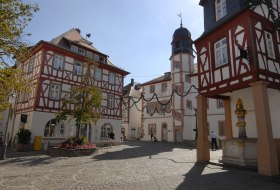
Until the end of the 18th century, fish sold by fishermen from the Old Rhine were the main commodity traded at the fish market, alongside other goods. As numerous official warnings show, they fulfilled this obligation inadequately and reluctantly. The square is dominated by the city's former town hall with its striking polygonal stair tower. Today, it houses a carillon with a figure of ‘Volker von Alzey’. The Renaissance building itself was constructed in 1586 using stones from the demolished Weidas monastery. In the immediate…
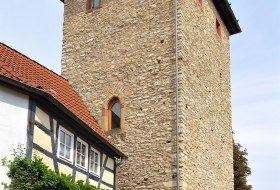
The Untertorturm is one of the seven towers of the Fleckenmauer wall built in the 15th century for protection. The gate, which was knocked down in 1840, was previously operated day and night. The battlements led around the tower over the gate to the other side of the street. Until the renovation in 1989, the high entrance in the west was the only access to the three-storey watchtower. Among other things, the tower served as a guardroom and probably also as the guard's flat. Text according to the signs on the tower with the kind permission of…
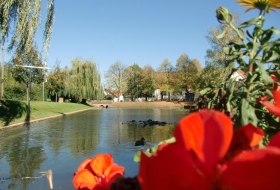
The old village pond in Mörstadt - the Woog, with its ancient tree population, is today an idyllic place for local recreation.