
searchMenu
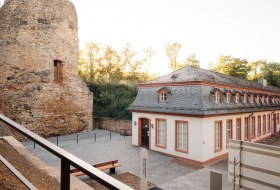
A mysterious atmosphere envelops the nighttime Mainz of Roman times. Soldiers in full armor gather around the fire of a large pyre, laying down weapons and spoils, while wails of mourning echo through the darkness and the flickering fire casts ghostly shadows on the nearby memorial. This could have looked like the annual death cult for General Drusus. Remains of the Drusus stone, regarded as an important Roman monument, can still be seen today on the grounds of the citadel. Nero Claudius Drusus, known simply as Drusus, was a stepson of…

The parish church of St. Quintin is considered the oldest parish church in Mainz and was first documented in 774. It is a late Gothic hall church that was built between 1288 and 1330. The tower, built in 1489, once housed a watchman's apartment. Today, it holds four bells, including the oldest bell in Mainz, the so-called “Lumpenglöckchen” – a bee-skein bell from around the year 1250. The high altar features a life-sized statue of Saint Quintin, the patron saint of prisoners, on the left, and Saint Blaise, the second…
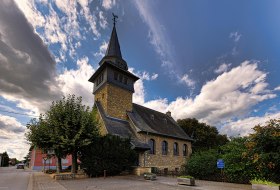
The Protestant church was built in 1910 in the Art Nouveau style, after the formerly Reformed church on Kirchstraße, dating back to 1739, had become too small and dilapidated. It is named after King Gustav II. Adolf, who entered the Thirty Years' War as a Protestant military leader of the Swedes in 1630. His likeness is depicted in a stained glass window on the west side. For four years, starting from the winter of 1631/32, the Swedes ruled over Ingelheimer Grund after they had expelled the Spanish occupation. The construction of the…

Join us on an exciting and impressive discovery tour in the heart of the medieval old town of Oppenheim. Our friendly and knowledgeable guides will show you the diverse facets and sights of our historically rich city - and of course some mysterious corners as well. Because it is certainly thrilling to follow in the footsteps of the many famous Oppenheimers and guests of the city, such as the Imperial Herald Kaspar Sturm, copper engraver Matthäus Merian, the builder of the Reichstag in Berlin, Paul Wallot, Martin Luther, or Albert…

The cabaret stage Oberhaus is a cultural highlight of the city centre in Alzey and offers a diverse program for every taste. No matter if it's comedy, cabaret or a live band, the stage offers enough space for every kind of art. Apart from that the visitors can take part in whiskey tastings after their registration or they can prove their skills at a darts competition. Also there are parties in the Oberhaus on a regular basis. The counter is with a length of ten meters one of the longest in Alzey, the musical entertainment is diverse, they…
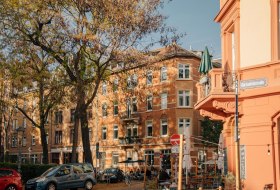
The city master builder Eduard Kreyßig (1830–1897) is responsible for giving the Neustadt its defining architectural and urban character, even though World War II left severe damages. Many Gründerzeit buildings, some with magnificent facades, as well as the prominently visible Christuskirche have, however, been preserved. In recent years, a careful renovation of the district has taken place. Modern architects and artists have enriched the appearance of the Neustadt with their buildings and artworks – for example,…
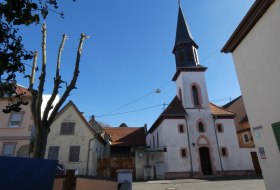
The present church, dedicated to St. Joseph, was built in 1891 and stands on the site of the Ursula Chapel, which was erected in 1745 and of which two sections of wall remain. During the First World War, the bells were melted down, and three new ones were cast in 1934, but two bells had to be surrendered again during the Second World War. In 1965, the church was extensively restored and given new windows. Particularly noteworthy is the rose window above the altar in the choir room, which depicts the Good Shepherd and scenes from the New…
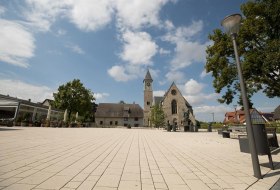
The Lindenplatz has been the focal point of Zornheim since the Middle Ages and was remodeled in 2015. In the Middle Ages, the local court met here, and the proceedings were held, as was customary at that time, outdoors under a tree. Zornheim chose a lime tree for this purpose, and since 2015, round linden trees have been planted alongside the large lime tree to complete the square. The central design element of the Lindenplatz is the Three Graces fountain, donated by the Peter Eugen Eckes family and realized by the Speyer artist Franz…