
searchMenu
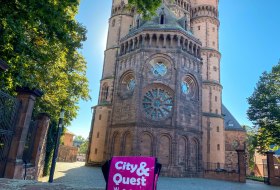
For those who enjoy solving puzzles and exploring cities in teams, "City&Quest" is an exciting, creative way to discover the city of the Nibelungs. Visitors can choose between a German or English version of the game. The game starts at the cathedral. From there, the approximately 3 km long route leads to 11 more puzzle stations worth seeing - most in the middle of the city centre, some a little outside. The tour takes about 2.5 hours on foot. With the help of the mobile phone's GPS function and a free app, you can find your way around…
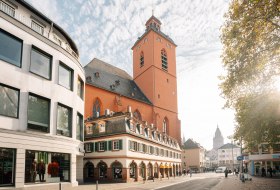
The parish church of St. Quintin is considered the oldest parish church in Mainz and was first documented in 774. It is a late Gothic hall church that was built between 1288 and 1330. The tower, built in 1489, once housed a watchman's apartment. Today, it holds four bells, including the oldest bell in Mainz, the so-called “Lumpenglöckchen” – a bee-skein bell from around the year 1250. The high altar features a life-sized statue of Saint Quintin, the patron saint of prisoners, on the left, and Saint Blaise, the second…

The tower built around the year 1000 and the old silent organ from 1784, along with the beautiful stained glass windows and a wing altar, provide a successful cross-section through different eras. During the Thirty Years' War and also in the War of the Palatine Succession, the church, regarded as the main fortification of the village, was heavily damaged and partially destroyed. In 1706, it was assigned to the Protestants, who renovated it with a flat ceiling in 1725. Even after several renovations, the overall structure of today's church…
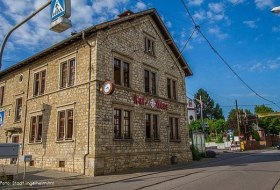
The rubble stone building with sandstone elements was constructed in 1857, according to the year inscribed on the wooden entrance door. The simple architecture of the two-story building with a gabled roof and tiny bell tower emphasizes the official character of the structure. Located on Binger Street, the building is of local historical significance as a former school and town hall.

The clock tower, which is under monumental protection, is the landmark of the municipality Neu-Bamberg. Once it belonged to the 3 gates of the town fortification. The village owes its origin to the Neue Baumburg (Novo Boinburc), which was founded by the Raugrafen in 1253 and whose ruins still characterise the townscape today. Restored half-timbered houses, farms, gardens and the old water house give the village centre on the castle hill its unique charm.
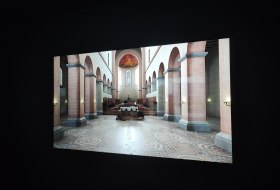
With the 'Elevator to the Past', the former Hildegard Monastery becomes tangible Almost 400 years ago, the proud Monastery of Rupertsberg, the place where Hildegard of Bingen worked, was burned down in the Thirty Years' War and reduced to ruins. In 1803, the grounds were then transferred into private ownership. The monastery arcades were walled up. In the Villa Rupertsberg, starting from the original monastery arcades of the Hildegard Church, the disappeared Hildegard Monastery has been revived and can be discovered with all senses through…

The Siefersheim Höllberg comprises a rocky hilltop of rhyolite with a rare plant community of e.g. rock pears, medlars, roses and heather as well as a dense ring of woody plants on the slopes.
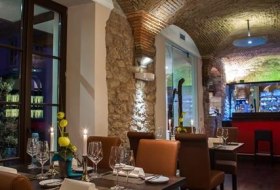
The cross vault cellar of the Spiess winery was rebuilt into a vinotheque. Food, home owned wines as well as colourful lighting provide the right atmosphere. General information about Rheinhessen cow chapels The origin of the typical Rheinhessen vaults goes back to the early 19th century. At that time, farmers wanted to increase the yield of their cattle by keeping them in stables and use the leftovers as fertiliser for their fields. Initially, the cattle were housed on the ground floor of the half-timbered houses, above which hay and…