
searchMenu

The Catholic Parish Church of St. Gereon, built in 1716, is imposingly situated on a hill that offers visitors a wonderful view of the surrounding countryside. The church is listed as an architectural monument in the list of cultural monuments in Rhineland-Palatinate and houses an impressive high altar (1698) and beautiful ceiling paintings in the choir room by Hans Thumann from 1936. The RheinTerrassenWeg leads directly past the baroque hall building.

Colloquially, the building is jokingly referred to as "Fuchsbau" – in reference to the then-serving mayor Jockel Fuchs – or "officials' prison." It is undoubtedly a distinctive building with its own, unmistakable form language. For five centuries, Mainz had no town hall until the city council commissioned the renowned Danish architectural firm Jacobsen and Weitling to design a new building in 1968. Otto Weitling, one of the architects, expressed his hopes in 1974: "We believe we have created a place of high value that will arouse…
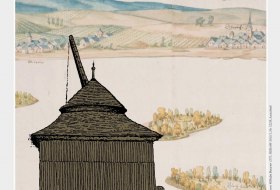
Already in the 14th century, a ship's crane is evidenced at the Frei-Weinheimer bank. A first massive land crane was erected in 1549 after the model of the Binger crane (1487). The still visible foundation is a relic of the last crane powered by human labor, which was built around 1680. The rotating crane stand was embedded in the central shaft, to which the two tread wheels and the jib were attached. Two workers had to walk in the wheels to provide the drive for the system. Unloading and loading were subject to fees. The crane clerk kept a…

The water tower built in 1906 on the Höllberg near Wöllstein is considered a landmark of the place. The listed tower was restored in 2025. It is a popular meeting point and picnic area and is located on the Küstenweg Rheinhessen hiking trail.
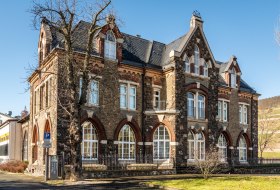
With the Hildegard jubilee in 1998, the Historical Museum on the River - Hildegard von Bingen, the former electricity generating station on the bank of the Rhine River, opened its doors. There is a large department dedicated to Hildegard, the universal scholar and theologist. The museum offers something very special: a complete set of surgical instruments from the Roman days, discovered during renovation work in Bingen. A further department focuses on the Rhine Romantic epoch. In a unique way, the 200-year epoch is illustrated using, among…
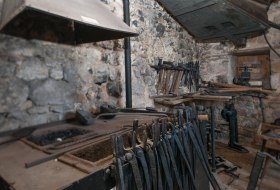
Built in 1750. The village blacksmith shoed horses, produced waggon wheel metal for carriages and repared small devices for the agriculture and the wine growing. The last active blacksmith let the fire go out forever in 1959. In 1989 the municipality could buy the forge together with its furniture and preserved an authentic testimony through useful additions of the equipment.
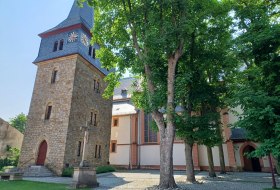
The builders who had previously worked under Jacob von Landshut in Herrnsheim constructed the new, uniform church building in Bechtolsheim between 1482 and 1492. The building, which appears compact from the outside with its high gabled roof and separate bell tower, offers an overwhelming impression of space inside with its wide, light-filled hall. The choir and nave are the same height inside and are spanned by a vault with a seemingly endless pattern. The creation of this outstanding building is probably thanks to Philipp Kämmerer von…

The historic site where Martin Luther was questioned before emperor and empire on 17th and 18th April 1521 is today situated in a romantic landscape garden, the Heylshofpark. The former bishop's court that stood on this site was destroyed in 1689. The residence of the bishop of Worms was built on the north side of the cathedral until the destruction of the city in 1689. King Charles V lived here during the 1521 Reichstag, and Martin Luther was brought here on 17 and 18 April, where he acknowledged his writings and refused to revoke them: It…