
searchMenu
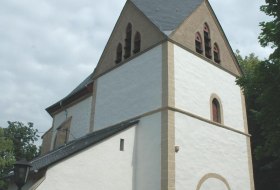
From the place there is a large baroque staircase from the year 1741 leading up to the small Catholic church of St. Wigbert. The uniqueness of the console figures, as well as the figurative representation of angels, apostles, and the decorative painting, make the church a significant architectural monument of the Middle Rhine region. Particularly noteworthy are the Romanesque choir from 1107, the new diamond roof from around 1850, Gothic wall paintings from the 15th and 16th centuries, as well as the richly decorated neo-Gothic altar from…

The south-eastern wall tower of the Flörsheim-Dalsheim Fleckenmauer is the simplest wall tower.

The Teekännchen, the special feel-good oasis in the heart of Ingelheim, enchants with its appealing, homely atmosphere and unusual variety of products, coffee specialities, over 400 types of tea, handmade waffles and cakes, decorative or gift articles, tableware and much more. Let us inspire you too!

The oldest Jewish cemetery in Europe has around 2,000 graves, the oldest gravestone dates from around 1058/1059 and is part of the UNESCO World Heritage SchUM Sites Speyer, Worms, Mainz - Jewish Heritage for the World. From the part on the former city rampart you have an impressive view of the cathedral, the so-called "Martin Buber View". The old Jewish cemetery "Heiliger Sand" is still of great importance to Jews worldwide. Numerous influential Jewish scholars and rabbis were buried here. The oldest gravestones date back to 1058/59 and thus…

For several centuries, ship mills operated on the Rhine River near Ginsheim. Up to 21 of these floating small businesses for grain processing were anchored here simultaneously, before they had to make way for the rising industrialization and increasing shipping traffic. Today, the authentic reconstruction of the last productive Rhine ship mill offers interesting and exciting insights into the technology and working conditions of past times.
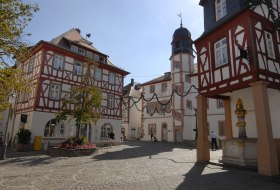
Until the end of the 18th century, fish sold by fishermen from the Old Rhine were the main commodity traded at the fish market, alongside other goods. As numerous official warnings show, they fulfilled this obligation inadequately and reluctantly. The square is dominated by the city's former town hall with its striking polygonal stair tower. Today, it houses a carillon with a figure of ‘Volker von Alzey’. The Renaissance building itself was constructed in 1586 using stones from the demolished Weidas monastery. In the immediate…

This defensive tower is a part of the Staufer fortifications and was presumably established around 1160. The “Bolander” secured the southwest side of the Ingelheim palace and the “Rheingässer Tor.” An early pictorial representation of the hall area (name of the archaeological zone Kaiserpfalz Ingelheim since the early modern period) from the year 1545 by Sebastian Münster shows the original multi-storey tower with arrow slits and battlements (illustration in the museum at the Kaiserpfalz). The name…

Hinkelstein A Hinkelstein has been mentioned at this location since the 14th century. The original stone is very likely built into the dry stone wall. The current stone was erected in 2004 and originates from a foundation uncovered during sewer construction in Osthofen, alongside which Roman bricks were also found. Height: 188 District: "Am Hinkelstein" History / Stories / Anecdotes: A Hinkelstein has been mentioned here since around 1300. According to the Monzernheimer chronicler, teacher Georg Wendel, it was removed…