
searchMenu

The red hillside is a wine growing area with special optics between Nierstein and Nackenheim. The former formation emerged over 280 million years ago because of a collapse of the rhine ditch between the basin of Mainz and the upper rhine ditch. Another special feature is the red ground which was also determining for the name. The colouring happened because of embedded iron compounds which emerged under the subtropic climate of another era. The substance of the ground is consists of clay and sandstone and in combination with the climate…
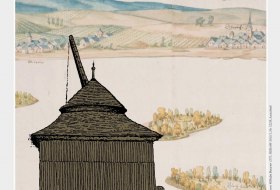
Already in the 14th century, a ship's crane is evidenced at the Frei-Weinheimer bank. A first massive land crane was erected in 1549 after the model of the Binger crane (1487). The still visible foundation is a relic of the last crane powered by human labor, which was built around 1680. The rotating crane stand was embedded in the central shaft, to which the two tread wheels and the jib were attached. Two workers had to walk in the wheels to provide the drive for the system. Unloading and loading were subject to fees. The crane clerk kept a…
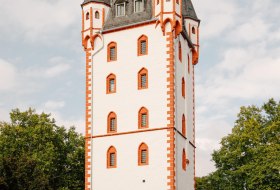
The facade is structured by pointed arch blind frame windows arranged evenly. Above the gate opening, there are two large niches on the city side, containing paired pointed arch windows and reliefs in the spandrels: to the left, the busts of a king, and to the right, a pair of patricians with a hairband. Comparable stone half-figures of bourgeois couples from the 14th century, originally from the war-destroyed house "Zum Molsberg," are now preserved in the state museum. The pointed arch, hollowed gate passage is vaulted with ribbed vaulting…

Located in the heart of the Rhine-Main region, with excellent access to Frankfurt am Main International Airport, HALLE 45, with its nearly 7,000 sqm of event space, is now the largest industrial venue around Frankfurt a.M. and Mainz. It captivates with its unique charm and utmost flexibility in terms of room design. On the historic site of the Old Wagon Factory in Mainz, you have a total of 6,800 sqm of event space, which is distributed among five locations and a total of 18 breakout and meeting rooms. Office hours: Monday to Friday, 9 AM…

Above the castle, on the walled former cemetery, stands the evangelical church of St. Peter, which originally served as a fortified church. Castle and church used to be connected by an underground passage. When the Romanesque church was destroyed by fire in 1435, the tabernacle with the hosts inside miraculously remained intact. This so-called "Miracle of the Host" gave rise to pilgrimages. The new church was completed in late Gothic style at the end of the 15th century. With its old paintings and grave commemorative plaques, it is an…
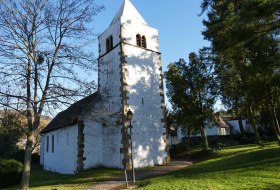
Bad Münster am Stein - Ebernbu
Surrounded by shady trees, the Old Johanneskirche, the oldest preserved building in the district of Ebernburg and indeed the entire city, stands in the cemetery. The whitewashed church was built before the year 1200 and was first mentioned in writing in 1212. Its location between the hill of Ebernburg and the massive porphyry masses of the Rotenfels gives the place a particularly romantic aura. The church was part of the city wall, which is why it was called a fortified church. The marked feature is the pyramid-shaped roof of the square…

The rectangular hall building is medieval at its core and was rebuilt in 1616. The west tower of today's Protestant parish church dates back to 1914.

This defensive tower “die Schnecke” (the snail) controlled the former defensive wall, situated between the midle Altegässer and the now equally torn down Hammergässer Gate, (crossing: Unterer Zwerchweg/Mühlstraße). The weighty building from the end of the 14th century was still not roughcast in1900, so that the interesting construction of foundation and pointed cone roof can be easily recognised, a technique that can also be seen on the “Trulli” in the vineyards.