
searchMenu

Today, the house is a two-storey residential building and is considered the oldest house in the district of Dalsheim. Probably after the destruction in the Palatinate War of Succession in 1689, the building was renovated in 1716 according to the date above the door. The foundations, cellar and window jambs indicate that the building was originally built about 150 years earlier, in the 16th century. The upper storey is adorned all around with Franconian half-timbering, which was put back under plaster on the street side during the last…
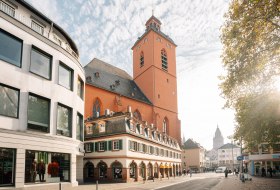
The parish church of St. Quintin is considered the oldest parish church in Mainz and was first documented in 774. It is a late Gothic hall church that was built between 1288 and 1330. The tower, built in 1489, once housed a watchman's apartment. Today, it holds four bells, including the oldest bell in Mainz, the so-called “Lumpenglöckchen” – a bee-skein bell from around the year 1250. The high altar features a life-sized statue of Saint Quintin, the patron saint of prisoners, on the left, and Saint Blaise, the second…

The Catholic St. Lawrence Church, located in close proximity to the Protestant St. Lawrence Church, is a neoclassical hall building from 1837 (cool style, Moller school) with good acoustics. Since 1999, the church features a pyramid-shaped tower top, with a touch of Lower Rhenish Romanesque. The current organ, consisting of parts of the old "Schlimbach" organ from 1897 and the former cathedral organ, was built in 1969 by the former pastor Klein from Wörrstadt. Inside the church, there is also a permanent exhibition of old liturgical…
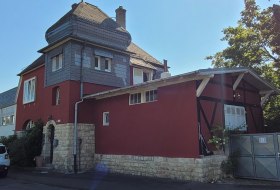
From 1904, Frei-Weinheim had a railway connection for goods and passenger traffic for exactly 50 years. The former train station building in Heimat style is still preserved. The single-track Selztalbahn connected the Rheinhessen hinterland from Jugenheim-Partenheim to the port in Frei-Weinheim. In Nieder-Ingelheim, there was a connection to the left bank Ludwigsbahn, which had been running between Mainz and Bingen since 1859. Since the Selztalbahn was primarily used for the transport of sugar beets, it was nicknamed…
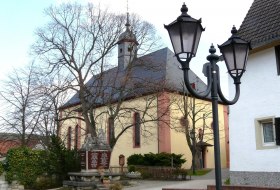
The formerly Gothic church was devastated, and the consecration of the current Baroque church took place in the year 1715. The preserved chancel of the former church is still used today as a sacristy. The Baroque altars, which are unusual for a small village church, are particularly noteworthy. From this period date the donation box and the baptismal font. The colored stained glass windows designed by an artist from Mainz in 1906 depict beautiful saint motifs. Next to the high altar, one can see the statues of the church patrons Philip and…

The historic site where Martin Luther was questioned before emperor and empire on 17th and 18th April 1521 is today situated in a romantic landscape garden, the Heylshofpark. The former bishop's court that stood on this site was destroyed in 1689. The residence of the bishop of Worms was built on the north side of the cathedral until the destruction of the city in 1689. King Charles V lived here during the 1521 Reichstag, and Martin Luther was brought here on 17 and 18 April, where he acknowledged his writings and refused to revoke them: It…
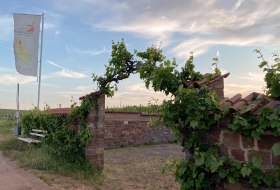
The so-called "Mistkaut" between Nierstein and Nackenheim in the midst of the vineyards on the "Rote Hang" is directly located on the "RheinTerrassenWeg" and the "Butttenmännie-Wanderweg". This relic of earlier times in agriculture and viticulture was previously used as a storage place for manure. Today, wine tastings and celebrations take place there. Its name comes from a rock niche (Kaut) in the Rotliegend. This was formed by the extraction of gravel (Kummer), which was used as fertilizer. Due to its high potassium content, the…
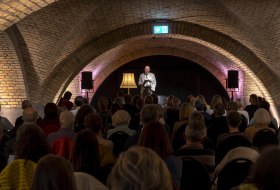
The vaulted cellar in the first basement of the Ingelheim Winzerkeller has established itself as a venue for cabaret. It has become a stage for many well-known authors who read from their works. Of course, there is also an interesting music programme.