
searchMenu

The Cultural Forum Partenheim was founded in 2002 at the initiative of Werner Repovs. The association aims to organize events with historical and contemporary connections to Partenheim. We want to make the local history visible and tangible and show that customs can be really fun. This includes the traditional village festivals like Eierweinfest, Kerb, and the Bremserabend. At the initiative of Michelle Drais and Willi Brummer, two historical books have been created, which depict the history of Partenheim as well as the village life as…
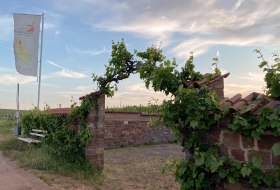
The so-called "Mistkaut" between Nierstein and Nackenheim in the midst of the vineyards on the "Rote Hang" is directly located on the "RheinTerrassenWeg" and the "Butttenmännie-Wanderweg". This relic of earlier times in agriculture and viticulture was previously used as a storage place for manure. Today, wine tastings and celebrations take place there. Its name comes from a rock niche (Kaut) in the Rotliegend. This was formed by the extraction of gravel (Kummer), which was used as fertilizer. Due to its high potassium content, the…
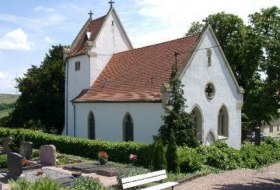
The baptismal church of Hildegard of Bingen in Bermersheim v.d.H. has been used repeatedly since the Reformation and finally to the present day as a Simultankirche - a church used separately by both denominations. This is a Franken characteristic and it stands under the patron of Saint Martinus.
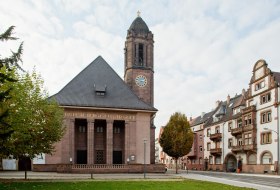
The Lutheran church in the west of the city centre was built between 1910 and 1912 according to plans by Prof. Friedrich Pützer. It is easy to recognise the strong echoes of Darmstadt Art Nouveau with sparse ornamentation on the outside. The octagonal Luther rose appears several times throughout the church. The single-nave hall building has a pulpit altar.
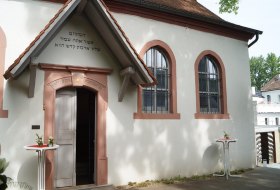
During the siege of Mainz in 1793, the synagogue was heavily damaged, but the repairs took 25 years. In the Night of Broken Glass in 1938, National Socialists looted and desecrated the building, but did not set it on fire to protect neighboring houses. In 1940, the synagogue and its property were sold under duress and later used as a shed and chicken coop. The significance of the synagogue was forgotten until the exhibition "Jews in Mainz" brought it back to public consciousness in 1978. The hidden building was placed under monument…

The Schillerplatz is one of the central and historically significant squares in Mainz. Named after the poet Friedrich Schiller, it is today a lively meeting place with a striking historical backdrop, characterized by magnificent noble palaces such as the Osteiner Hof and the Erthaler Hof. Its baroque appearance bears witness to the urban development of past centuries, and the square is closely linked to the Mainz Carnival: Every year on November 11th, the fifth season is ceremoniously opened here. In the center of the square, the Carnival…
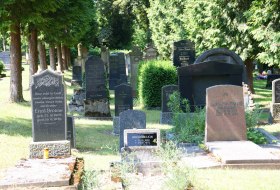
Since 1381, Jews have been documented as residing in Wörrstadt, as at that time a "Jewish gate" was mentioned for the first time. The designation refers to a gate on the access or exit road of the fortifications. There were also the "Jewish gardens," which were vegetable gardens located outside the village (today to the left and right of Talstraße). Around 1800, there was already a Jewish burial site located on "Kehlberg" (now Eichenring), but it was no longer in use by 1870/1873. Eight gravestones can still be seen in this…

Already in 1394 a communal bakery was mentioned in Wackernheim. The last one was built around 1840, after the old oven and building had fallen into very poor condition. According to old tradition, the house along with the oven and garden was leased to a baker for an annual rent. The baker was responsible for the maintenance of the bakery. The stone oven was attached to the north side of the house. To the east was the associated bakery garden. The baker produced the desired number of loaves of bread from the flour brought to him by the people…