
searchMenu
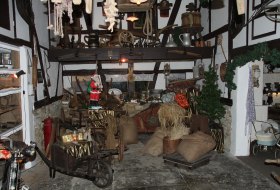
The estate of Eckhard and Hildegund Müller is a half-timbered house from the year 1748. As early as 1720, the property, which then belonged to Jakob Jakobs from Ensheim, contained a dilapidated residential house, a support barn, an old, crumbling stable, and a wine press. In the following years, the estate changed hands multiple times: After Petri, Zengerle, and Steil, Peter Keller acquired it from Konrad Mann at auction. Until 1823, Andreas Mayerhöfer is named as the owner, followed by Philipp Schmitt I in 1831, Heinrich Schmitt…

The Catholic Parish Church of St. Gereon, built in 1716, is imposingly situated on a hill that offers visitors a wonderful view of the surrounding countryside. The church is listed as an architectural monument in the list of cultural monuments in Rhineland-Palatinate and houses an impressive high altar (1698) and beautiful ceiling paintings in the choir room by Hans Thumann from 1936. The RheinTerrassenWeg leads directly past the baroque hall building.
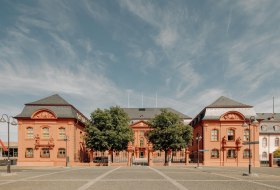
With its central location on the Rhine in the historic heart of Mainz, the Rhineland-Palatinate State Parliament is a special place both politically and architecturally. It resides in the traditional Deutschhaus, a magnificent Baroque building from the 18th century, which, after extensive restoration, combines modern parliamentary work with historical flair. As the seat of the Rhineland-Palatinate state parliament, the building represents lived democracy and the political history of the federal state. Visitors have the opportunity to get to…

Between the 12th and 18th centuries, various knightly families settled in Saulheim. One of them was Ritter Hundt - today's symbolic figure of the village. According to legend, the local citizen won all drinking competitions with his great thirst for wine and became famous for it as far away as Mainz. A stone monument of him stands today in the middle of the village, next to the building of the Mainzer Volksbank. Sightseeing: Open to the public
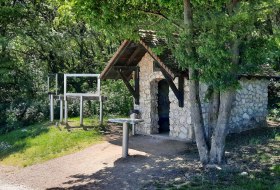
The Falkenberghütte, located above Dienheim, offers hikers along the RheinTerrassenWeg the opportunity to take a break. The hut, donated by the Dienheim Reconstruction Community, invites for a well-deserved rest after an eventful hike through the beautiful landscape. Two large panoramic windows reveal a fascinating panorama that opens up the view towards the historic Oppenheim and the charming Dienheim. The gentle hills of Rheinhessen with their picturesque vineyards provide a dreamy backdrop for beautiful photo motifs.
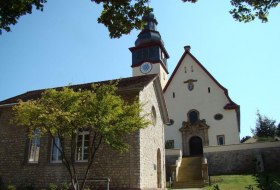
The 38-meter-high church tower of the Protestant church stands prominently visible and was inaugurated in 1910 after 17 months of construction. The organ, the ceiling painting, and the colorful windows radiate a special beauty. The interior of the church is designed according to the so-called "Wiesbaden Program." Accordingly, the altar, organ, and pulpit form a unity as they lie on a visual axis.

On the KulTOUR from the castle tower to Froschmühle Nierstein-Schwabsburg, you will travel back to the 13th century and learn more about the old bakery in Schwabsburg and the Froschmühle. The tour starts at the Schwabsburg castle tower. All you need for this tour is a smartphone with a QR code scanner. Each building on the tour has a QR code with interesting facts behind it. A total of 6 stations invite you to get to know Nierstein-Schwabsburg better on your own. After the tour, you can stop off at one of the restaurants around the…
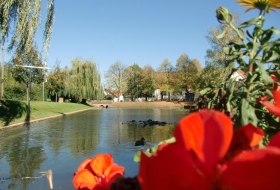
The old village pond in Mörstadt - the Woog, with its ancient tree population, is today an idyllic place for local recreation.