
searchMenu
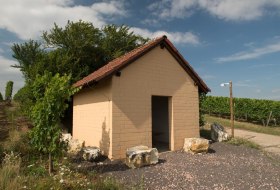
The Wineyard-House "Schindegaul" is a small refuge which, like many others of its kind, offers shelter or a dry shelter to winegrowers, but also to hikers or cyclists in bad weather.

Water House Built in 1905 in the Art Nouveau style for the water supply of Westhofen. In the 1960s, the pressure was no longer sufficient, and it was decommissioned. History and Stories Prominently visible, the water house from 1905, built in the Art Nouveau style, reflects the self-understanding of that era. Wilhelm II aspired to great power, rearmed, annexed land overseas, and constructed. The buildings always represented the thoughts of their respective time and their rulers; so does our water house,…
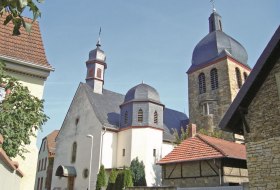
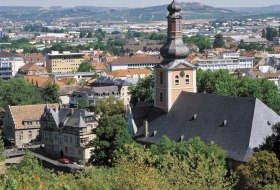
The Catholic church was built in 1760/62 as a Baroque hall incorporating older building fabric. The St. Stephan's Monastery in Mainz was able to finance the choir, as it was obligated to maintain the choir as a recipient of the fruit tithe. The Electoral Palatine ecclesiastical administration paid for the costs of the nave. The ridge turret with bell was a gift from the Gottesthal Monastery in Mittelheim in the Rheingau. It was not until 1928 that the square bell tower was added according to the design of Philipp Starck, an architect from…
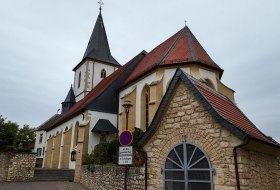
The church is the oldest building in the town. There was originally a wooden basilica here, which was mentioned as early as the 9th century, followed by a stone building from the 13th century. The choir with sacristy visible today dates from 1492 and the tower was built around 1520 as a defensive tower. The nave was expanded into three naves in 1911 based on Gothic styles.
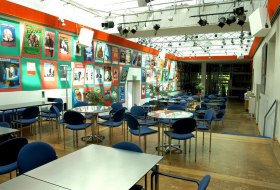
Since its founding in 1966, the Unterhaus in Mainz has been one of the most renowned venues for cabaret and small-scale arts in Germany. In the characteristic vaults of the stage, both established artists and emerging talents perform – always with the aim of creatively reflecting current events and moving the audience to laugh, think, and empathize. In addition to a versatile stage program, the Unterhaus is the annual host of the German Small Arts Prize, one of the most significant awards of its kind. This makes the theater not only a…

The former estate belonged to the family of Wackernheim's mayor Heinrich Klippel since the beginning of the 19th century. Through marriage, the property passed to Heinrich Krebs, who originated from the Heidesheim sand mill. In the 1860s, he housed and cared for the community bull. The keeping of the so-called "Faselochsen" (breeding bull) was clearly regulated and supervised by the district office in Bingen. The tenant had to purchase the bull at his own expense. The community paid a fixed annual amount for the maintenance of the animal. The…
600 years alone on the island St. Paul's Church Out of the pedestrian zone and into the largest church nave between Mainz and Trier, not far from the Alte Nahebrücke bridge. The space impresses with its simple size. The fact that it is largely devoid of ornamentation is in keeping with the tradition of the Reformed congregation, who have used the church as the leading denomination since 1585. Visitors are surrounded by light, peace and harmony. Only the oak pulpit attracts attention. A boy, interpreted as an angel without wings, sits on…

On a terrain between Stiegelgasse and Jungfernpfad which is now settled again, there was the synagogue, built in 1841 as “a nice copy of oriental style” .The entrance was in Stielgelgasse. Crossing a small garden, the gate was reached. A side door led to the female emporium, another to the emplacement of the choir, where the organ was also situated. The main hall had 10-12 rows with 5 to 6 seats each on both sides. The Torah case was at the end of the hall on an elevated place. There both reading and the sermon took place. The…