
searchMenu
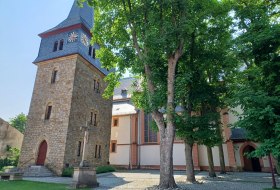
The builders who had previously worked under Jacob von Landshut in Herrnsheim constructed the new, uniform church building in Bechtolsheim between 1482 and 1492. The building, which appears compact from the outside with its high gabled roof and separate bell tower, offers an overwhelming impression of space inside with its wide, light-filled hall. The choir and nave are the same height inside and are spanned by a vault with a seemingly endless pattern. The creation of this outstanding building is probably thanks to Philipp Kämmerer von…
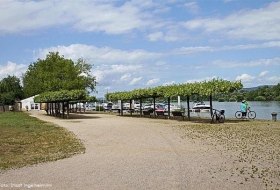
From 2001 to 2004, the Rhine riverbank in Heidenfahrt was extensively redesigned. Today, the riverscape combines local recreation and nature conservation and is particularly one of the most popular destinations in the region during the summer months. Some highlights of the river section include the promenade and sunbathing lawn, numerous waterfowl near the shore, and a fantastic view of the Rheingau.
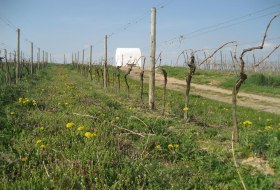
The Trullo - the Trulli - the special little vineyard house in Rheinhessen. Former shelters in the vineyards for the workers, but also intended for the "Wingertschütz" who guarded the vineyards. This vineyard hut stands out in its form. Its barrel roof is unique in the whole area.
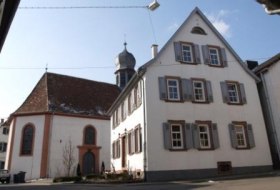
Former Lutheran church, built 1738-42 in rural baroque style - tower 1930, three-sided hall, stucco ceiling and furnishings from the time of construction, "pneumatic cone chest organ" from the workshop Förster & Nikolaus Lich/Upper Hesse from 1915, also called winter church, since the installation of a church heating system at the end of the 19th century. Text Signposting with kind permission of the Orsgemeinde Flörsheim-Dalsheim This location is part of an audiovisual route and offers the possibility to watch/listen to…

The cabaret stage Oberhaus is a cultural highlight of the city centre in Alzey and offers a diverse program for every taste. No matter if it's comedy, cabaret or a live band, the stage offers enough space for every kind of art. Apart from that the visitors can take part in whiskey tastings after their registration or they can prove their skills at a darts competition. Also there are parties in the Oberhaus on a regular basis. The counter is with a length of ten meters one of the longest in Alzey, the musical entertainment is diverse, they…
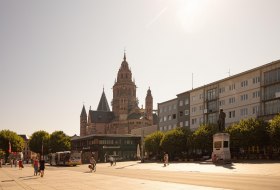
The Gutenbergplatz in Mainz is named after the city's famous son, Johannes Gutenberg, and serves as a central hub in the old town. At its center stands the bronze statue of Gutenberg, designed in 1837 by Bertel Thorvaldsen and extensively restored in 2010, depicting the inventor of the printing press in an idealized form. Around the monument, there is a lively atmosphere: cafés, shops, and cultural events shape the vibrant ambiance of the square. Annually, celebrations such as the Johannisfest take place here, honoring the famous Mainz…

The church has developed over time into a defining landmark of the region. Even from a distance, the tower, which is over 60 meters high, indicates the former importance of the place, which once held city rights. The construction of the triple-naved church took place relatively quickly between 1431 and around 1475. The last Count of Veldenz and his son-in-law, who founded a new line of the Wittelsbach family with the House of Simmern-Zweibrücken, were the patrons. A prominently displayed foundation plaque above the entrance –…

The individual graduation towers are between 70 and 350 metres long and 9 metres high, embedded in a rocky valley, where thermal healing water trickles down from the 500-metre-deep spring and a fresh sea breeze blows with an evaporation area of 16,000 square metres in the Salinental valley. From 1732 - 1998 salt for baths and foods was produced with the help of these salt waterfalls.