
searchMenu

The quietly splashing Neuborn spring, which is located in the forest recreation area Neuborn, offers cool refreshment and feeds the nearby Neuborn spa.

At this location, there is a well shaft that was situated beneath an asphalt surface until 2012. As part of the urban renovation, the Saalbrunnen has once again become a component of the local landscape. Today, travertine blocks mark its location. The location of the Saalbrunnen is particularly interesting: It is precisely at the intersection of the longitudinal and transverse axes of the Carolingian core buildings. Thus, the location of the Saalbrunnen marked the center of the palatial complex around the year 800. The symmetrical…

The town hall in Bodenheim is a typical example of the Franconian-Hessian half-timbered construction style of the Renaissance around 1600 and is considered one of the most beautiful half-timbered houses in Rheinhessen. The renovation was completed in 2023; it now shines in new splendour in the old town centre of the wine-growing community of Bodenheim. It was built in 1608 under the then lord of the village, Provost Anton Walpot von Bassenheim, as a new courthouse for the Mainz Knights' Abbey of St Alban. In the bay window, we recognise the…
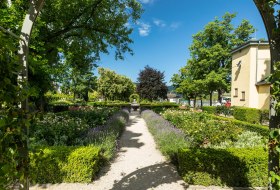
Bingen is located in the UNESCO World Heritage Middle Rhine Valley . The city is surrounded by fantastic countryside and towns. But Bingen itself has just as much to offer. The best example is the Cultural Shore. Here you stroll through beautiful parks and gardens. Here you admire artistic monuments and sculptures. Here you experience first-class music and cultural events . Head to the Rhine and discover what else there is to explore. Every three years, the Skulpturen-Triennale takes place in Bingen. Artists from…

The sculpture ‘Die Wolke’ (The Cloud, 1968/69, bronze) by Eberhard Linke at the starting point of the Hiwweltour Aulheimer Tal is a reference to the sculpture collection of the Eberhard and Barbara Linke Foundation. The sculptures can be viewed from May to October, Saturdays from 2 pm to 6 pm. Address: Erbes-Büdesheimer Straße 7, 55237 Flonheim Admission free

Above the town of Nierstein, located to the north in the Red Slope, lies the Wart Tower – the landmark of the town and one of the most beautiful viewpoints in the region. From here, an impressive panorama of the vineyards and the Rhine Valley opens up, extending to the Donnersberg, the Hessian Bergstraße, into the Taunus, as well as to Wiesbaden, Mainz, and the Rhine-Main area. Its origin dates back to a medieval signal tower from the 12th century. The stones from the demolished Kings Chair between Nierstein and Lörzweiler…

The Kirschbühl Hollow To describe the formation of a hollow way, one cannot avoid taking a look at the loess. The loess that was blown to us during the last Ice Age consists of 20% lime and remains stable in its angular shape at the cliff edges and in the hollow ways. By driving vehicles on the hollow ways, in earlier years with carts and livestock, the loess is loosened and turns to dust. During heavy rain, the loose soil is washed away, leading to ever-deepening paths - a hollow way is created. Today, many hollow ways are paved to…
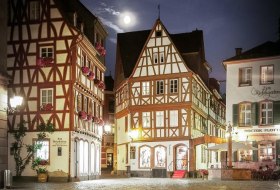
With the proceeds from the house at Aschaffenberg, Gutenberg's cousin Arnold Gelthus co-signed for the start-up financing of the printing workshop in Humbrechthof. Today, it is the oldest half-timbered house in Mainz, located in the picturesque Kirschgarten - right in the heart of the charming old town.