
searchMenu

The Roman Tower in the Guntersblum vineyards is a popular excursion destination right on the RheinTerrassenWeg. The lookout tower, constructed in 1998, is 9.8 m high. After 19 steps, you will find a covered viewing platform with an impressive panoramic view over the Rhine Valley, the Odenwald, the Taunus, and on clear days even up to Frankfurt. The tower recalls Guntersblum's Roman past: the Roman Tower stands near the site where a Roman Villa Rustica with a wine cellar was discovered a few years ago. Tip: From the end of April to…

The access to the fountain path is hidden at the far end of this square. If you follow the narrow path to the left, the fountain path leads close to the narrow buildings along the Zuckerberg area. The origin of the name "Brunnenpfad" is unknown. Presumably it was a path the residents used to reach wells outside the fortified defensive walls. The so-called health fountain is also located at this circular route station. A staircase leads to the spring water, which gushes 4 meters below the surface, which used to be routed through a brick…

The museum exhibits original finds from the Urrhine near Eppelsheim, which are around 10 million years old, and casts or copies of rare fossils. These include teeth and bone fragments of rhinoceroses, great apes and proboscis animals such as dinotheria and mastodons. Single specimens of the primeval horse, tapi r( claw-footed hoofed animal), Muntja deer, bear hound, beaver and pig are also on display. The centrepiece of the museum is a cast of the skull of a Dinotherium (Dinotherium giganteum), which was recovered from Klipstein and Kaup in…
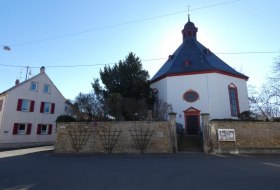
The Protestant church in Uelversheim is a special church, built in 1722 in the Baroque style as an octagonal central building. The original furnishings are still preserved today and convey an authentic impression of times gone by. In the center of the church building, along the main axis from west to east, you will find the altar, the pulpit, and the organ with its magnificent Rococo facade from 1754, crowned by trumpet-blowing angels. The gallery, which surrounds the room on five sides, was extended in 1836. The 20 balustrade panels of the…

The Bunte Bühne has been providing theater enjoyment in Armsheim for over 20 years. The repertoire includes comedies, farces, and crime comedies written by internationally known theater authors. The stage is a registered society and a member of the Rheinland-Pfalz state association of German amateur theaters. Rehearsals: At the beginning of the new playing season mainly on Tuesdays and Thursdays at 8 PM, by prior arrangement/planning. We traditionally perform on the first weekends in November - usually five performances.
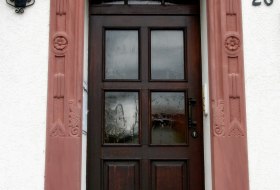
The door frame of the private property Zuckerberg 26 dates from the year 1612. At this time Ingelheim was under the government of the Electorate of the Palatinate. The door frame is no longer in its original position today Place, but probably belonged to the Electoral Palatinate Schaffnerei, which in the area of former Aula regia (throne hall) had been built. The Schaffnerei was the seat of the government administrator, who in Ingelheim Represented the interests of the Electoral Palatinate. Under the Ingelheim taxes to the Kur- pfalz were…

At the mouth of the Nahe into the Rhine - a wonderful spot for views of the Upper Middle Rhine Valley and the Rheingau. Perfect, as the sun sets directly behind the Mouse Tower.
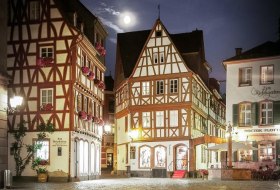
With the proceeds from the house at Aschaffenberg, Gutenberg's cousin Arnold Gelthus co-signed for the start-up financing of the printing workshop in Humbrechthof. Today, it is the oldest half-timbered house in Mainz, located in the picturesque Kirschgarten - right in the heart of the charming old town.