
searchMenu

On the KulTOUR from the castle tower to Froschmühle Nierstein-Schwabsburg, you will travel back to the 13th century and learn more about the old bakery in Schwabsburg and the Froschmühle. The tour starts at the Schwabsburg castle tower. All you need for this tour is a smartphone with a QR code scanner. Each building on the tour has a QR code with interesting facts behind it. A total of 6 stations invite you to get to know Nierstein-Schwabsburg better on your own. After the tour, you can stop off at one of the restaurants around the…
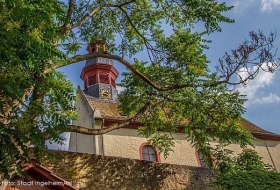
Already in 788, a church dedicated to Saint Martin is mentioned in a document from Fulda. At that time, the church was in the possession of the local noble family of Otakar. In 1348, it belonged as a parish church to the Wackernheim church community. In the mid-16th century, at the instigation of the Electoral Palatinate, first the Lutheran and then the Reformed confession was introduced. During the church division, the heavily damaged church, which had been severely affected by the Thirty Years' War, fell to the Reformed, who made up the…
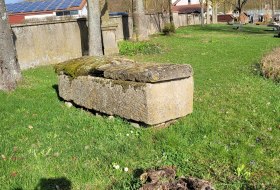
During a vineyard rearrangement in 1978, three adjacent sarcophagi were found and excavated on the hilltop "Greifenberg." The investigation by employees of the State Monuments Office in Mainz revealed that they date back to the 4th century AD. One of the sarcophagi is now located in the Sulzheim cemetery. The grave goods, glass jugs and glass vials, are housed in the museum in Alzey.
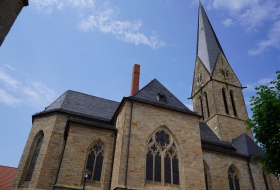
The Protestant church of Nieder-Saulheim was built between 1885 and 1886, after the previous building collapsed about 50 years earlier. It is a neo-Gothic hall with a transept and a recessed, vaulted choir. The comparatively tall, gable-crowned west tower has a square base and culminates in a classic helmet roof. Above the nave and the transept, wooden ribbed vaults rest on thin cast iron columns, while the extended side aisles feature transverse vaults and suspended galleries. Particularly worth seeing is a Gothic font from the 13th…

The clock tower, which is under monumental protection, is the landmark of the municipality Neu-Bamberg. Once it belonged to the 3 gates of the town fortification. The village owes its origin to the Neue Baumburg (Novo Boinburc), which was founded by the Raugrafen in 1253 and whose ruins still characterise the townscape today. Restored half-timbered houses, farms, gardens and the old water house give the village centre on the castle hill its unique charm.
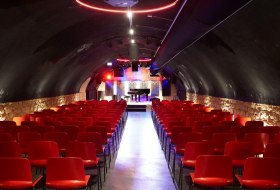
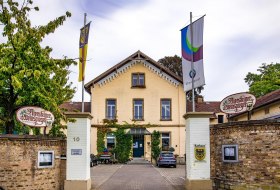
An extraordinary event location in the vault of a listed winery ensemble. This place in the geographical heart of Rheinhessen is a must-see. Cabaret, comedy, readings, classical & jazz concerts, as well as chanson evenings - Mathias Richling, Wladimir Kaminer, the Leipzig String Quartet, Wolfgang Haffner, Jasmin Tabatabai, all have been here and left an enthusiastic audience each time. Those who wish can dine in style at the castle before the events or spend the night in the hotel rooms of the old half-timbered house after the…
On the KulTOUR from the town hall to the Wartturm Nierstein, you can expect exciting information about the oldest vineyard in Germany, noblemen in Nierstein and a medieval signal tower. The tour starts at Nierstein's present-day town hall at Bildstockstraße 10. All you need for this tour is a smartphone with a QR code scanner. Each building on the tour has a QR code with interesting facts behind it. A total of 10 stations invite you to get to know Nierstein better on your own. After the tour, you can stop off at one of the restaurants…

Hinkelstein A Hinkelstein has been mentioned at this location since the 14th century. The original stone is very likely built into the dry stone wall. The current stone was erected in 2004 and originates from a foundation uncovered during sewer construction in Osthofen, alongside which Roman bricks were also found. Height: 188 District: "Am Hinkelstein" History / Stories / Anecdotes: A Hinkelstein has been mentioned here since around 1300. According to the Monzernheimer chronicler, teacher Georg Wendel, it was removed…