
searchMenu
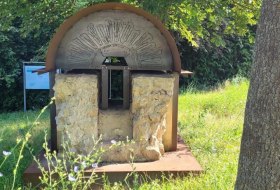
Here you see a section of an early medieval long-distance water pipeline. It was found in 2004 in close proximity. Scientifically, it has been dated to the construction period of the Imperial Palace, namely the late 8th century AD. The long-distance water pipeline supplied high-quality drinking water from the spring area "Karlsquelle" near Heidesheim through the Wackernheimer Valley to Nieder-Ingelheim, into the palace of Charlemagne. This was achieved through a 6.8 km long canal, which mostly ran underground. The structure, built from…

Directly next to the marketplace stands the Catholic parish church of St. Cosmas and Damian, whose tower, over 60 meters high, is visible from afar. The church was built in 1889 on the foundations of a medieval predecessor church. What many do not know: The flat passage under the choir is a true insider tip, as the arches bear the stone mason's mark of Johann von Diepach – a fascinating detail for history enthusiasts.
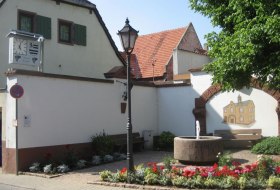
The town hall of the Kriegsheim municipality stood on this site. It was demolished in 1986. Afterwards, the "village square" was created, which is often used as a meeting place and experiences an annual highlight with the Kriegsheimer Kerwe and the "Kerweredd" held there. Kriegsheim was an independent municipality until 1969, when it was incorporated into the municipality of Monsheim. Since the administrative reform of 1972, the community has belonged to the municipality of Monsheim. Text taken from Rundgang Kriegsheim with kind permission.

The former Augustinian Canons' Monastery, today the Catholic Church of the Assumption of the Virgin Mary, is located in the centre of Pfaffen-Schwabenheim. The impressive buildings from the 12th to 18th centuries are among the most important cultural monuments between the Rhine and Nahe rivers. You will find Romanesque, early Gothic and Baroque building elements. The baroque high altar from 1714 and the baroque Heilmann organ from 1775 are particularly worth seeing. The adjoining monastery is now privately owned. On the 1st weekend in August,…
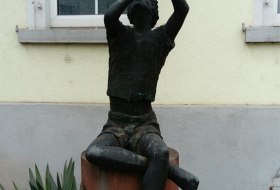
The Flute Player Fountain was inaugurated on 5 May 1990 with a village festival attended by a large number of people. It is a bronze sculpture by Grustav Nonnenmacher, an outstanding formative artist from Worms who has created numerous works. Nonnenmacher integrated one of the old sandstone troughs donated by Kurt Bernhard into the fountain. The flute player symbolises the cheerfulness of the people of Rheinhessen who live here. A boy as a musician, warbling into the air, legs crossed, content with himself and the world. The fountain was…
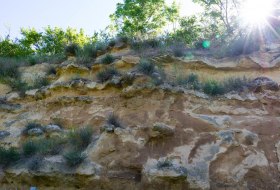
The Geotope in Alzey-Weinheim shows sea deposits from the time of Tertiar (Oligozän) over 30 Million years ago. It is also a former seabed, not a coastal cliff.
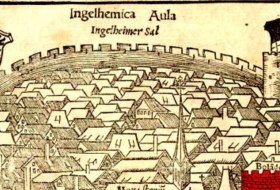
This defensive tower is a part of the Staufer fortifications and was presumably established around 1160. The “Bolander” secured the southwest side of the Ingelheim palace and the “Rheingässer Tor.” An early pictorial representation of the hall area (name of the archaeological zone Kaiserpfalz Ingelheim since the early modern period) from the year 1545 by Sebastian Münster shows the original multi-storey tower with arrow slits and battlements (illustration in the museum at the Kaiserpfalz). The name…
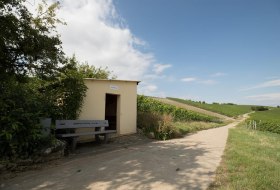
The Wineyard House "Am Hohberg" is located in the middle of the vineyard and marks the final climb back up the Hiwweltour Zornheimer Berg.