
searchMenu
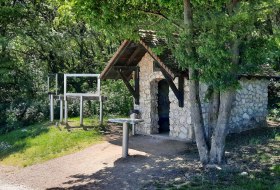
The Falkenberghütte, located above Dienheim, offers hikers along the RheinTerrassenWeg the opportunity to take a break. The hut, donated by the Dienheim Reconstruction Community, invites for a well-deserved rest after an eventful hike through the beautiful landscape. Two large panoramic windows reveal a fascinating panorama that opens up the view towards the historic Oppenheim and the charming Dienheim. The gentle hills of Rheinhessen with their picturesque vineyards provide a dreamy backdrop for beautiful photo motifs.
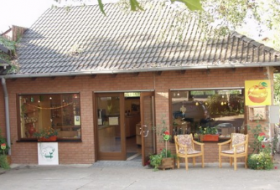
The farm shop offers a selection of freshly harvested as well as storable fruits. Which fruits are currently ripe can be seen at any time on the homepage. In addition, the range includes numerous products made with care from our own production, including jams, jellies, syrups, juices, pure apple juices, spirits, strawberry punch, and fruit secco. The offering is complemented by selected products from local farmers. Right next to the farm shop is a self-service booth that allows for the purchase of selected products even outside regular…
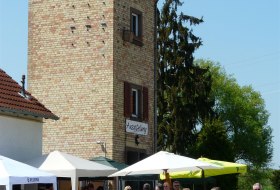
The Old Transformer Tower in Sulzheim combines history, art, and nature across three levels. For more than five decades, the building served to convert medium voltage to low voltage, thereby securing the electricity supply of the town. With the laying of all cables underground in 2009, the tower lost its original function and was subsequently sold. A private owner took over the structure with the aim of creating a place for encounters. Today, the transformer tower houses public exhibitions as well as events related to art and music.…
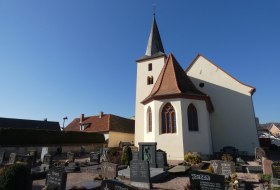
The church contains Romanesque, Gothic, and Baroque elements. The flat-roofed choir was built in the mid-15th century and decorated with extensive wall paintings. On the left wall, there is a large painting of the Virgin Mary with her cloak spread out protectively. Saints are depicted between the four tracery windows. The base floor is decorated with a painted vine carpet, and the figures are crowned with rich faux architecture. Source: Liebfrauenland - Gothic in Rheinhessen

The foundation stone for the construction of the synagogue was laid in 1855, which was acquired by the local community in 1900 for use as a kindergarten. The synagogue served as a church only until the year 1874. After that, the building came into the possession of the Protestant parish, which originally wanted to demolish it to build a community center. However, due to the objection from the state monument preservation, this did not happen. Even today, the synagogue is used as a Protestant community center.
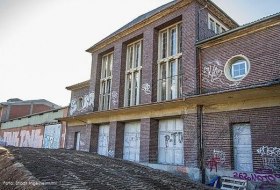
The market hall, built from 1920 to 1921 predominantly in dressed red sandstone near the train station, is considered an important functional building of the early 20th century, which still has a significant impact on the local landscape due to its location and size.
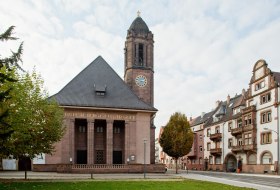
The Lutheran church in the west of the city centre was built between 1910 and 1912 according to plans by Prof. Friedrich Pützer. It is easy to recognise the strong echoes of Darmstadt Art Nouveau with sparse ornamentation on the outside. The octagonal Luther rose appears several times throughout the church. The single-nave hall building has a pulpit altar.
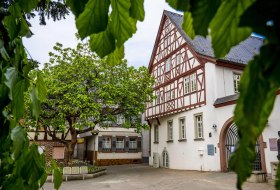
The museum offers insights into the life of the author who was born in Bingen in 1868. You can also see his writing desk, part of his bequest libary, examples of different book designs and editions as well as foreign language translations of George´s works and several sculptures.