
searchMenu
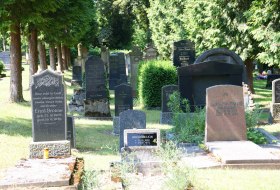
Since 1381, Jews have been documented as residing in Wörrstadt, as at that time a "Jewish gate" was mentioned for the first time. The designation refers to a gate on the access or exit road of the fortifications. There were also the "Jewish gardens," which were vegetable gardens located outside the village (today to the left and right of Talstraße). Around 1800, there was already a Jewish burial site located on "Kehlberg" (now Eichenring), but it was no longer in use by 1870/1873. Eight gravestones can still be seen in this…

During the Reformation, Spiesheim had a parish church dedicated to Saint Stephen, which served the Reformed community as a place of worship until 1706. Due to the Palatine church division, the community lost its church and acquired a barn "Auf dem Liding," which was subsequently used for services. Initial plans for a new church were created in 1788, and a year later, the foundation work began. However, financial constraints, French occupation, two wars, and the integration of Rheinhessen into the Grand Duchy of Hesse-Darmstadt delayed…
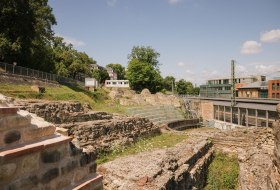
The Roman Theater in Mainz is one of the largest ancient stage buildings north of the Alps. Built presumably in the 1st century AD, it was located on the southern slope of the Kästrich, below the present-day citadel. With a stage width of about 42 meters and an audience diameter of 116 meters, the theater could accommodate around 10,000 visitors – an impressive scale that clearly illustrates the importance of Mogontiacum, Roman Mainz. Theaters of this kind were central places of public life in the Roman Empire and reflected the…
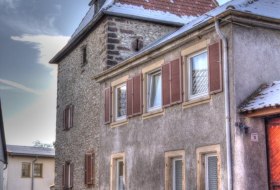
Built in the 14th century. The lords of Kriegsheim built this building, which is probably the oldest preserved residential building in the municipality. In the 16th century, the residential tower belonged half to the Counts of Leiningen-Hartenberg and half to those of Rodenstein. The three-storey building radiates a certain security and tranquillity, which the observer still feels today. The residential tower is privately owned. Text taken from Rundgang Kriegsheim with kind permission.
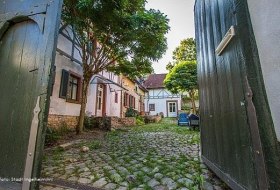
The building substance of the property largely dates back to the mid-19th century. Typical for the locality, the residential building features a solid masonry ground floor and a half-timbered upper floor. This house included six living spaces. The outbuildings were exclusively constructed from rubble stone. The courtyard is accessed through a gate structure with large wooden wings. The builder at that time was the municipal tax collector Nikolaus Kloos. In 1849, he succeeded the democratically minded mayor Johann Heinrich Klippel in office as…
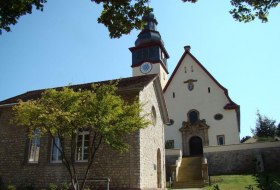
The 38-meter-high church tower of the Protestant church stands prominently visible and was inaugurated in 1910 after 17 months of construction. The organ, the ceiling painting, and the colorful windows radiate a special beauty. The interior of the church is designed according to the so-called "Wiesbaden Program." Accordingly, the altar, organ, and pulpit form a unity as they lie on a visual axis.

The cabaret stage Oberhaus is a cultural highlight of the city centre in Alzey and offers a diverse program for every taste. No matter if it's comedy, cabaret or a live band, the stage offers enough space for every kind of art. Apart from that the visitors can take part in whiskey tastings after their registration or they can prove their skills at a darts competition. Also there are parties in the Oberhaus on a regular basis. The counter is with a length of ten meters one of the longest in Alzey, the musical entertainment is diverse, they…