
searchMenu

The clock tower, which is under monumental protection, is the landmark of the municipality Neu-Bamberg. Once it belonged to the 3 gates of the town fortification. The village owes its origin to the Neue Baumburg (Novo Boinburc), which was founded by the Raugrafen in 1253 and whose ruins still characterise the townscape today. Restored half-timbered houses, farms, gardens and the old water house give the village centre on the castle hill its unique charm.
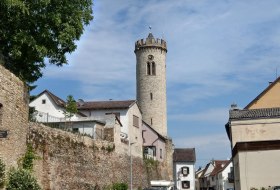
The clock tower in Oppenheim was built in 1843/44 on the remains of a former defensive tower of the medieval town fortifications in the neo-Gothic style. The tower is around 31 meters high and houses a viewing platform, among other things. The tower clock from 1907, which is still in working order, chimes the half and full hours. The building is maintained by the Friends of the Clock Tower in Oppenheim am Rhein and is a listed building. Further information can be found at www.uhrturm-oppenheim.de .
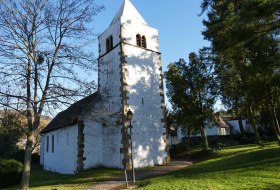
Bad Münster am Stein - Ebernbu
Surrounded by shady trees, the Old Johanneskirche, the oldest preserved building in the district of Ebernburg and indeed the entire city, stands in the cemetery. The whitewashed church was built before the year 1200 and was first mentioned in writing in 1212. Its location between the hill of Ebernburg and the massive porphyry masses of the Rotenfels gives the place a particularly romantic aura. The church was part of the city wall, which is why it was called a fortified church. The marked feature is the pyramid-shaped roof of the square…
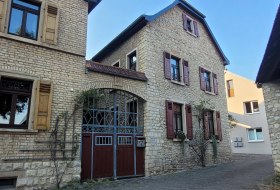
Here once stood the Catholic school building, which was built in 1857. Already in 1850, the Catholic priest of Heidesheim, Heinrich Berthes, had promised the church fund the donation of this property. It was to serve as housing for clergy, accommodation for the organist and the bell ringer, as well as a classroom for the Catholic confessional school. Until the introduction of communal schools, the Catholic teacher Josef Becker from Heidesheim lived and taught here. Afterwards, the house was rented out and finally auctioned off in 1896 to…
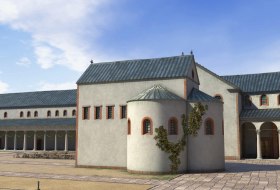
In 2004, two predecessor buildings of the Saal Church were discovered during archaeological excavations on the Saalplatz. The older of these buildings is a so-called tri-apsidal church (Trikonchos), named after its three semicircular building ends, which resemble the shape of a cloverleaf remember. It is an ancient building with a reference to Byzantine architecture. The eleven metre long sacred building from the 8th or The 9th century was connected to the north wing. Recent research suggests that it was a stately private chapel. Later the…
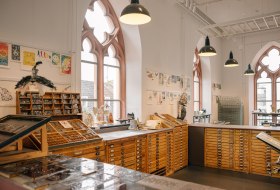
The printing shop in the Gutenberg Museum Mainz serves as both a print workshop and an experimental laboratory, forming the central museum educational offering of the institution. Here, visitors of all ages – from children to teenagers to adults – can experience the "black art" of printing up close, design their own printed materials, and experiment with lead and wood types as well as printing presses. Numerous workshops, guided tours, and creative programs such as children's birthdays or holiday offers convey the history of the…

In 2010, the site of the starling defence transmitter was converted into an approx. 4 m high observation tower with a great view of the Rhine plain, Flörsheim-Dalsheim and the surrounding area, and in 2016, panorama panels describing the view were added.
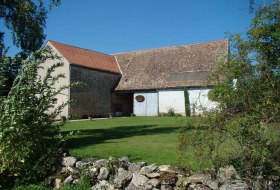
The Johanniterhof was first mentioned in a document in 1306. Parts of the building fabric are even older. After 500 years of belonging to the Order of St. John, the estate was divided into three manor farms under Napoleon. The former size of the entire complex is still clearly recognizable today.