
searchMenu

The Old Signal Box was built in 1899 at the intersection of the railway lines Alzey – Bingen and Alzey – Mainz. It was decommissioned in 2007. Today, train control is handled by electronic signal box technology. The Old Signal Box Armsheim Nord (An) is the only one of its kind (mechanical Stahmer signal box technology) in Rheinhessen, where all technical facilities of the block and lever systems, as well as the tensioning system, are completely preserved. Thus, visitors can closely experience how the work of a pointsman was until…

For centuries there has been a large country estate just outside the medieval town wall of Bad Kreuznach - today it is a romantic tree garden, which was created in the 19th century as a landscape park. The pond in the park dates back to the 18th century, when a moated castle stood here. Over the years, however, the park was repeatedly redesigned by its changing owners. Today, the Schlosspark Museum is located in the middle of the park, which together with the pond forms an aesthetic unit that in itself is worth visiting.

Since its reopening in 1991, the Frankfurter Hof in Mainz's old town has established itself as a central cultural center of the city. National and international artists make the venue widely known beyond the Rhine-Main area. The program includes a diverse spectrum of music, theater, exhibitions, classical music, pop culture, and multicultural offerings. During the concert series "Summer in the City," more impressive open-air locations in Mainz are also used in the summer. The history of the Frankfurter Hof dates back 175 years: In the…
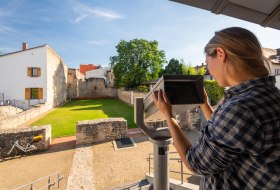
The Aula regia, the throne hall of the Ingelheim imperial palace, was built at the end of the 8th century and is part of the founding building under Karl the great (747 / 48−814). The throne hall was the most important public building and served as a representative meeting place. This shows also on the basis of their high-quality building equipment, the remains of which were found during archaeological excavations. Parts of the from antiquity Inspired building jewelry, including fragments of the wall paintings and the precious…
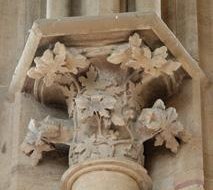
Of the Templar church of a moated castle in the Appelbach valley, first mentioned in 1258, only the choir, consisting of a pre-joch and 5/8 end, has survived. It lies hidden in the middle of a farm. The extremely high quality architecture is decorated with naturalistic leaf capitals. These outstanding works belong to the circle of the so-called "Naumburg Master", one of the best sculptors of the 13th century. He was trained in Reims and helped to teach the new forms of architecture on his way via Noyon, Mainz and Naumburg. The small, precious…
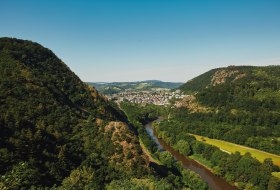
Shaped from fire and water: The Goose Rock Formation From the Salinental, one looks eastwards to a rock formation that looks like a huge slagheap. This was given its name in Celtic times: "Ganda", i.e. steep slope with rock debris. Elementary forces have shaped the goose. 280 million years ago, magma came to the surface from the earth's interior, solidified and formed a rock massif to which both Rotenfels and Rheingrafenstein belong. The Nahe - Celtic "Nawa" - carved its way into this rock and dug its way deeper and deeper into it. This is…
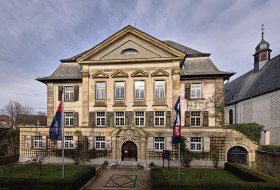
The neighbouring earlier Hessen Amtsgericht is a neo baroque complex, whose 3 wings encase a courtyard open to the south. This palace-like estate was built between 1907 and 1909, according to plans of the Hessisches Hochbauamt Darmstadt. The facade of the main building is dominated by a triangular gable. An open stair leds to an admirably rounded portal guarded by pillars above which a coat of arms with the inscription “Hessisches Amtsgericht” is preserved. At the end of the 20th century these premises were sold by the state…
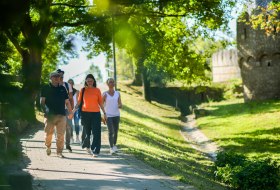
On the east flank of the Mainzer Berg the old defences are particularly massive and here are probably the best remaining parts of the wall, watchtowers and the low laying obstacle in the ditch. Here the Breitbach feeds the ditch. The romantic part along the so called Seufzerpfädchen (path of sighs) - it was the path where lovers used to meet - runs from Rinderbach (now Schillerplatz) to the traditional red-wine festival site and meets the outer courtyard at the Burgkirche – the starting point for every round-trip of the city…