
searchMenu
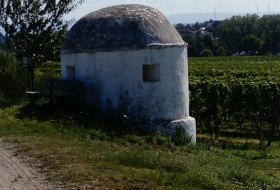
The trullo, the trulli - the special little vineyard house in Rheinhessen. Former shelters in the vineyards for the workers, but also intended for the "Wingertsschütz" who guarded the vineyards.
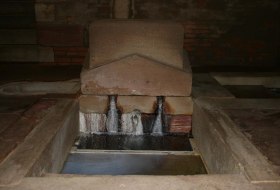
The Sironabad in Nierstein was a former Roman bathhouse with two sulfur springs and two freshwater springs. The springs led to early settlements, as finds from Celtic, early Germanic, and Roman times clearly prove. The sulfur spring of the Sironabad was rediscovered in 1802 after being buried for centuries. During cleanup work, copper coins dated 87 to 267 AD and small figurines were found in stone basins surrounded by plaster balls. These finds prove beyond doubt that the fountain was in operation during this period and was used by the…

The Excellent Heisje This trullo also belongs to the trulli commissioned by Unterfauth Hirschel and was therefore built in 1766. It was awarded the title "Excellent" in 1996 by the Wine Brotherhood of Rheinhessen. The award plaque is located to the left of the entrance and proves that it is a prize-winning vineyard house. Height: 190 District: "Am Moorstein" District: 1282: Marstene 1509: morsteyn 1934: Am Moorstein 1953: Hinter dem Morstein Today: Am Moorstein Here we rely on pure speculation. The current spelling…
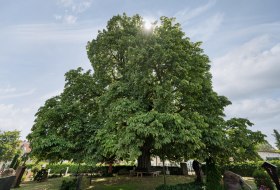
A true natural monument is the over 370-year-old horse chestnut tree in the Ockenheim cemetery. With a trunk circumference of 5 meters and an impressive crown diameter of 25 meters, it is not only the oldest horse chestnut in Rheinhessen, but also one of the oldest in all of Germany. A true wonder of nature that you shouldn't miss!
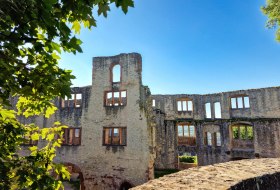
Welcome to a tour through the history of the old imperial town of Oppenheim from its beginnings in the 12th century to its destruction in 1689. An easy walk takes you to the Landskron ruins above the town, past our famous St. Catherine's Church and the ossuary, the stately Burgmannen houses and the remains of our medieval town wall. You will be rewarded with a sweeping view over the town and the Rhine Valley. Private tour for closed groups (max. 20 people) Duration approx. 1.5 hours Barrier-free access Bookable all year round Prices…

As early as 1888, the world’s deepest sparkling wine cellar was created beneath the main building of the traditional Kupferberg sparkling wine cellar. Spanning over seven levels, more than 60 rooms extend up to 50 meters underground – an impressive testament to centuries of craftsmanship and sparkling wine tradition. Today, the Kupferberg Terrace uniquely combines history and enjoyment. During tours, visitors can explore the historic vaulted cellars and learn more about the rich history of Kupferberg. Additionally, the Mainz…
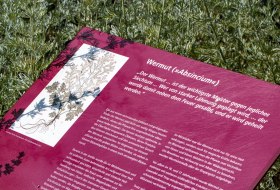
As a supplement to the Hildegard exhibition in the neighboring Museum am Strom, the garden displays numerous plants that Hildegard described in her natural history ("Physica"). In this important collection, the learned Benedictine described almost 300 herbs, shrubs and trees with their (healing) effects on humans. Unfortunately, the work has survived only in late medieval copies, so that today no one knows the "original text" of Hildegard von Bingen. The didactically designed Hilde Garden presents the "Book of Plants" and the "Book of Trees"…
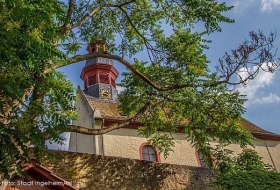
Already in 788, a church dedicated to Saint Martin is mentioned in a document from Fulda. At that time, the church was in the possession of the local noble family of Otakar. In 1348, it belonged as a parish church to the Wackernheim church community. In the mid-16th century, at the instigation of the Electoral Palatinate, first the Lutheran and then the Reformed confession was introduced. During the church division, the heavily damaged church, which had been severely affected by the Thirty Years' War, fell to the Reformed, who made up the…