
searchMenu

Here you have the opportunity to take a holiday photo of a special kind. Capture a beautiful holiday memory with the charming Rheinhessen landscape. The 70-hour campaign of the Federation of German Rural Youth in May 2019 was a complete success for the local group Monzernheim. Through collaborative efforts, the rural youth from Wonnegau were able to implement their idea of picture frames and thereby enhance the tourist offerings in the region. Once the steel constructions, each adorned with two Rural Youth logos, were completed, they could…


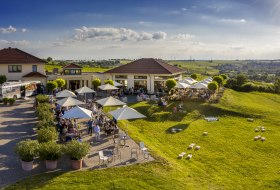
We, Anna and Stefan Raddeck, love wine and we want to share this passion with you. Since 2003, we have been working in a controlled ecological manner to preserve the excellent quality of our wines for future generations. Reducing yields, long maceration times, and partial spontaneous fermentation make our wines authentic and complex. This is especially true for our Rieslings from the renowned sites Schloss Schwabsburg, Heiligenbaum, Pettenthal, and Orbel from the Red Slope. Since 2009, the winery has been located in the middle of the…
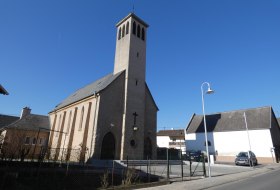
The Catholic Church in Köngernheim is a branch church of St. Walburga in Friesenheim and today belongs to the parish of St. Mary Magdalene. Since its foundation in 2016, this parish has comprised the parishes of Friesenheim, Undenheim, and Weinolsheim. The church was consecrated in 1932. The interior of the church building is a simple space.
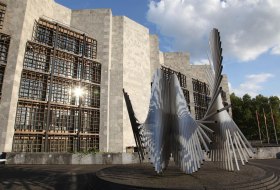
Colloquially, the building is jokingly referred to as "Fuchsbau" – in reference to the then-serving mayor Jockel Fuchs – or "officials' prison." It is undoubtedly a distinctive building with its own, unmistakable form language. For five centuries, Mainz had no town hall until the city council commissioned the renowned Danish architectural firm Jacobsen and Weitling to design a new building in 1968. Otto Weitling, one of the architects, expressed his hopes in 1974: "We believe we have created a place of high value that will arouse…
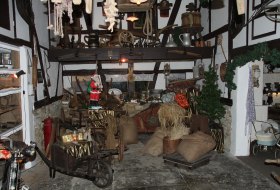
The estate of Eckhard and Hildegund Müller is a half-timbered house from the year 1748. As early as 1720, the property, which then belonged to Jakob Jakobs from Ensheim, contained a dilapidated residential house, a support barn, an old, crumbling stable, and a wine press. In the following years, the estate changed hands multiple times: After Petri, Zengerle, and Steil, Peter Keller acquired it from Konrad Mann at auction. Until 1823, Andreas Mayerhöfer is named as the owner, followed by Philipp Schmitt I in 1831, Heinrich Schmitt…

The Square Heisje The built-in ridge cap stone bears the year 1891. However, the Heisje is said to have actually been built in 1920. The peculiarity of this Heisje is that it is only half privately owned by the Christian Weinbach winery. The other half is rented by the winemaker. Height: 215 District: "Im Kelterstein" Interesting facts: The Heisje was built around 1920. It consists mostly of rubble stones, with the frames and corners made of bricks. The gable roof is made of reinforced concrete. The windows are designed…