
searchMenu
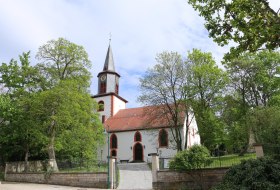
The former St. Lawrence Church mentioned today was referenced as a "fortified church" in 1152. It was a Romanesque three-nave pillar basilica. Apparently, there was already a smaller church in the 8th century. In 1226, the church was remodeled in the late Gothic style. The main nave originates from the 15th century, while the post-Gothic side aisles date back to the early 17th century. Romanesque elements in the choir, round arches, columns, and doorways can still be seen. Noteworthy are the huge old stone cross with a figure of Christ from…

The wine-growing community of Schornsheim was first mentioned in 782 AD in a deed of gift from Charlemagne to the Hersfeld monastery. He donated his Schornsheim treasury, including the church and land, to "Saint Lioba" as a retirement home. She is one of the most important women of the Middle Ages. Although Lioba of Tauberbischofsheim only lived in Schornsheim for a few months until her death, she is still very much present here today. She stands as a bronze Benedictine abbess in the middle of the village square, surrounded by an artificial…
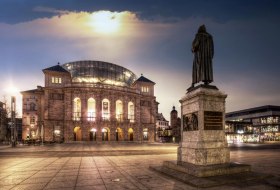
In life-size, Johannes Gutenberg rises on the square named after him. The bronze statue is crafted by the Danish sculptor Bertel Thorvaldsen and depicts the inventor of the printing press in an idealized form: bearded, elegantly dressed, with a Bible and typefaces in hand, as no contemporary portrait exists. At the inauguration in 1837, the people of Mainz celebrated for three days. Even today, the Gutenbergplatz around the monument is vibrant, especially during the Johannisnacht at the end of June, when the festival in honor of the famous…
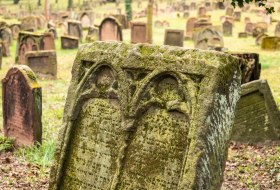
The oldest Jewish cemetery in Europe has around 2,000 graves, the oldest gravestone dates from around 1058/1059 and is part of the UNESCO World Heritage SchUM Sites Speyer, Worms, Mainz - Jewish Heritage for the World. From the part on the former city rampart you have an impressive view of the cathedral, the so-called "Martin Buber View". The old Jewish cemetery "Heiliger Sand" is still of great importance to Jews worldwide. Numerous influential Jewish scholars and rabbis were buried here. The oldest gravestones date back to 1058/59 and thus…

From Gau-Weinheim, you can reach the notable Kreuzkapelle located below the Wißberg amidst the vineyards. A well-known pilgrimage site, accessible via a beautiful panoramic walk through the vineyards. You shouldn't miss this. Follow the signs towards Kreuzkapelle.

The high altar of the Baroque church encloses an exquisite statue of Mary made of lime wood, which was created around 1470 in the Upper Rhine region. It probably originates from the previous building, which belonged to a pilgrim hospital on the Way of St. James in the Middle Ages.

A Baroque hall structure with a hip roof, built from 1747 to 1751, extension of the community center, the south forecourt, and the new sacristy in 1970/71. Until the early 1970s, the former Catholic school was located nearby. The origins of the Church of Walburga, which stood on the Selz south of the current town center, can be dated back to the late 9th century based on the patronage documented since 1328. The first mention as "capella," initially probably a branch of Engelstadt, under the patronage of the Mainz St. Mauritius Foundation, is…

Members of the Ordenstein family lived in Offstein from 1816 to 1861. Moritz Ordenstein married Johanna Scheuer from Kriegsheim in 1835. He is described in the personal documents as a "merchant". They had two children, daughter Elisabeth, who died only two days after birth in 1854. Son Heinrich was born on 7.01.1856. Moritz sold the Offstein property to Georg Andres l., and it was used for agriculture until about 1965. In 1861 the family moved to Martinsgasse 9 in Worms. Heinrich went to school in Worms and came into contact with music…