
searchMenu
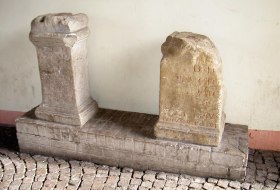
The cult of Mithras was brought to Mainz by Roman legionaries as early as the 2nd century. It was in direct competition with the emerging Christianity, as both religions showed some parallels. The underground sanctuaries, called Mithraea, consisted of elongated vaults with a Mithras altar at the end and were painted to resemble the starry sky. The followers of the cult therefore met underground, but symbolically under the canopy of heaven. The well-preserved altar is made of Odenwald marble. Its originally red inscription reads: “To…

Since its founding in 1966, the Unterhaus in Mainz has been one of the most renowned venues for cabaret and small-scale arts in Germany. In the characteristic vaults of the stage, both established artists and emerging talents perform – always with the aim of creatively reflecting current events and moving the audience to laugh, think, and empathize. In addition to a versatile stage program, the Unterhaus is the annual host of the German Small Arts Prize, one of the most significant awards of its kind. This makes the theater not only a…

Bad Münster am Stein - Ebernbu
Surrounded by shady trees, the Old Johanneskirche, the oldest preserved building in the district of Ebernburg and indeed the entire city, stands in the cemetery. The whitewashed church was built before the year 1200 and was first mentioned in writing in 1212. Its location between the hill of Ebernburg and the massive porphyry masses of the Rotenfels gives the place a particularly romantic aura. The church was part of the city wall, which is why it was called a fortified church. The marked feature is the pyramid-shaped roof of the square…

With the 'Elevator to the Past', the former Hildegard Monastery becomes tangible Almost 400 years ago, the proud Monastery of Rupertsberg, the place where Hildegard of Bingen worked, was burned down in the Thirty Years' War and reduced to ruins. In 1803, the grounds were then transferred into private ownership. The monastery arcades were walled up. In the Villa Rupertsberg, starting from the original monastery arcades of the Hildegard Church, the disappeared Hildegard Monastery has been revived and can be discovered with all senses through…

At the municipal cemetery, on the way to the village ditch (along the Evangelical church), there are gravestones from the 17th and 18th centuries. Among them are early classical tombstones. Between the funeral hall and the Catholic rectory stands a stone column crowned with an ancient helmet, a plate with flags, and a broken cannon. The memorial was erected for the soldiers from the canton of Wörrstadt who returned from or fell in the Napoleonic campaigns.

Important note: Guided tours of the cellar labyrinth can only be booked through the Oppenheim Tourist Information Office. Bookings, further information, and inquiries can only be made at: www.stadt-oppenheim.de/buchen | by telephone at 06133 4909-14 or 06133 4909-19 | or by email at tourismus@stadt-oppenheim.de Historic cellars beneath the old town With its extensive cellar complex, built between the 12th and 17th centuries, Oppenheim boasts a unique cultural monument. A circular tour through the underground town center of Oppenheim…

The Star Bank in Schwabenheim is the perfect place to be close to the sky. Here you can watch the stars, search for constellations, or simply enjoy the clear night sky. A romantic spot to experience the night and dream into the vast sky.

Protestant parish church, formerly St. Nicholas Collegiate Church. The large building with its high tower to the west dominates the Obermarkt with its long side. Despite severe damage during the War of the Palatinate Succession in 1689 and World War II, the three-nave hall offers an impressive, albeit somewhat austere, interior, due to the loss of most of its furnishings. Some of the tomb slabs erected in the nave originate from the Cistercian convent of Weidas, which was located near Dautenheim and was destroyed in the 16th century. The…